

You are not underfunded because money is scarce—you are underfunded because you are looking in the same places as everyone else, competing for the same visible grants, recycling the same strategies, and unknowingly ignoring an entire ecosystem of mental health funding opportunities that never show up on traditional platforms.
If you have been applying consistently, rewriting proposals, tweaking your language, and still receiving rejections or silence, the issue is not effort—it is visibility. Most organizations are chasing the top 30–40% of publicly advertised funding while completely missing the remaining 60% that flows quietly through networks, partnerships, intermediaries, and strategic relationships.
This guide will change how you think about funding forever. You will move from reactive searching to strategic discovery, from crowded competition to overlooked opportunity, and from guesswork to precision targeting. And once you see how funding actually flows behind the scenes, you will never rely solely on grant databases again.
Why Most Organizations Miss 60% of Mental Health Funding Opportunities
The biggest misconception in the nonprofit space is that funding is centralized and easily searchable, when in reality, the majority of funding for mental health programs is distributed through fragmented, relationship-driven, and often opaque channels that are not indexed on public platforms.
Most nonprofits rely heavily on popular grant databases, newsletters, and Google searches, which only surface opportunities that funders have chosen to publicly advertise. However, many foundations and corporate funders do not operate this way because they prefer curated pipelines, trusted intermediaries, or invitation-only funding cycles that reduce application volume and increase alignment.
From a reviewer’s perspective, publicly listed grants often receive hundreds or thousands of applications, many of which are misaligned or poorly positioned, creating an overwhelming filtering process. To counter this, funders increasingly rely on referrals, ecosystem partnerships, and previously funded networks to identify grantees, effectively bypassing the public altogether.
This creates a two-tier system: one highly visible and competitive, and another largely invisible but significantly less saturated. Organizations that remain in the first tier often interpret rejection as a lack of funding availability, when in fact they are simply competing in the wrong arena.
For example, a community-based mental health nonprofit in Nigeria may continuously apply to international open calls without success, while missing regional pooled funds, diaspora-led giving circles, and local corporate CSR initiatives that quietly fund similar programs with far less competition.
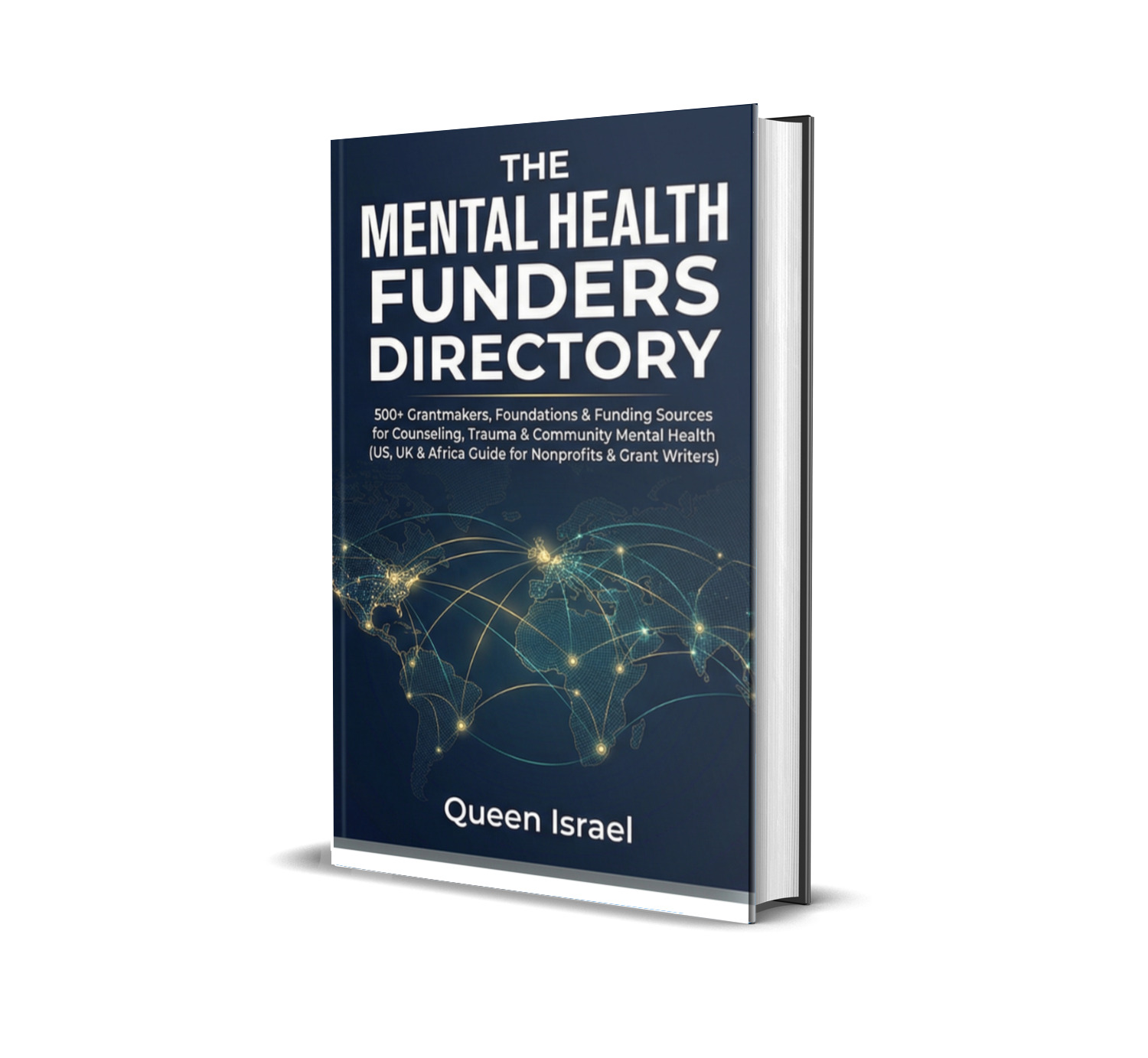
This is exactly why tools like The Mental Health Funders Directory: 500+ Grantmakers, Foundations & Funding Sources for Counseling, Trauma & Community Mental Health exist—not just to list funders, but to expose pathways that are not obvious, saving months of blind searching and positioning you where funding is actually accessible.
The Hidden Places Where Mental Health Grants Are Actually Found
Hidden mental health grants are not hidden by accident—they are embedded within ecosystems that require proximity, awareness, and strategic positioning to access.
One of the most overlooked spaces is intermediary organizations, which act as funding distributors on behalf of larger donors. These include regranting institutions, fiscal sponsors, and collaborative funding networks that receive large grants and then redistribute smaller amounts to grassroots organizations. These opportunities are rarely labeled as “grants” in traditional searches, yet they represent a significant portion of funding for mental health programs.
Another major channel is corporate social responsibility (CSR) pipelines, especially within industries directly or indirectly connected to mental health, such as healthcare, technology, financial services, and extractive industries operating in vulnerable communities. These corporations often fund mental health initiatives through partnerships rather than open applications, meaning organizations that build relationships or align their programming with corporate priorities gain access to funding streams that are invisible to the general public.
Faith-based networks also play a critical role, particularly in regions like Africa and parts of the UK and US, where religious institutions partner with foundations to deliver mental health interventions. These funds are often distributed through denominational structures, mission boards, or affiliated NGOs, creating another layer of hidden opportunity.
Consider a trauma counseling initiative that secures funding not through a public grant, but through a church network partnered with a private foundation focused on post-conflict recovery. Without understanding these pathways, the opportunity would never appear in a standard grant search.
This is where strategic intelligence becomes your advantage. When you begin to map where funding actually flows—not just where it is advertised—you shift from chasing opportunities to positioning yourself within funding ecosystems.
Overlooked Funding Sources Beyond Traditional Grant Databases
If your funding strategy begins and ends with platforms like grant directories or search engines, you are operating within a narrow slice of the available funding landscape. The most effective organizations expand beyond these tools and actively pursue alternative funding channels that are less visible but highly valuable.
One such channel is collaborative funding pools, where multiple funders combine resources to address large-scale mental health challenges such as youth suicide prevention, community trauma, or refugee mental health. These pools often work through selected partners or consortiums, meaning individual organizations must either join networks or position themselves as implementation partners to gain access.
Another overlooked source is government subcontracting opportunities, where large NGOs receive national or international funding and then subcontract smaller organizations to deliver localized services. These opportunities are rarely advertised as grants, yet they provide substantial funding for mental health programs with reduced competition.
Additionally, academic and research partnerships offer indirect funding opportunities, particularly for organizations involved in mental health data collection, pilot interventions, or community-based research. Universities often receive large research grants and seek nonprofit partners to execute community components, creating another pathway for funding that is often ignored.
A powerful example involves a youth mental health organization that partnered with a university-led research project on depression in underserved communities, securing multi-year funding without ever applying to a traditional grant call.
These are the kinds of opportunities that are systematically captured and organized within the Mental Health Funders Directory, allowing you to bypass months of fragmented research and immediately access funders and pathways that most organizations never discover.
How to Identify and Access These Hidden Opportunities Step-by-Step
Accessing hidden mental health grants requires a shift from passive searching to active intelligence gathering, relationship building, and ecosystem mapping.
The first step is to map your funding ecosystem, identifying all stakeholders connected to your area of work, including foundations, corporations, government agencies, intermediaries, and networks. This process reveals not just who funds mental health programs, but how funding flows between entities.
Next, you must analyze funded projects, not just open opportunities. By studying who has received funding, you uncover patterns, partnerships, and entry points that are not publicly advertised. This includes identifying repeat grantees, collaborative partners, and funding themes that indicate where future funding may be directed.
The third step is to position your organization strategically, aligning your programs with the priorities and language used by funders within your ecosystem. This increases your chances of being referred, invited, or included in funding pipelines that are not open to the public.
Relationship building is also critical. This does not mean generic networking, but targeted engagement with intermediaries, program officers, and partner organizations who can provide access to hidden opportunities.
Finally, you must systematize your discovery process, using tools, directories, and structured research methods to continuously uncover new funding sources rather than relying on sporadic searches.
This is where investing in resources like the Mental Health Funders Directory becomes a strategic advantage, as it consolidates verified funders and eliminates the inefficiency of scattered, time-consuming research.
How to Shift From Random Searching to Strategic Funding Discovery
The difference between organizations that struggle for funding and those that consistently secure it lies in their approach. Reactive organizations search for grants; strategic organizations build funding pipelines.
To make this shift, you must adopt a funder-centric mindset, understanding how and why funders allocate resources rather than simply looking for opportunities. This involves analyzing funding priorities, decision-making processes, and preferred partnership models.
You also need to diversify your funding strategy, ensuring that you are not dependent on a single type of funding source. This includes combining grants, partnerships, corporate funding, and indirect funding streams to create a more resilient financial structure.
Another key shift is moving from one-off applications to long-term positioning, where you continuously engage with funders, demonstrate impact, and build credibility over time. This increases your chances of receiving repeat funding and being included in invitation-only opportunities.
For example, an organization that consistently shares impact data, engages with funders beyond application cycles, and aligns its programs with emerging mental health priorities is far more likely to access hidden funding than one that only applies when opportunities are announced.
By leveraging structured tools like the Mental Health Funders Directory, you accelerate this transition, moving from scattered searching to a focused, strategic approach that significantly increases your funding success rate.
Frequently Asked Questions (FAQs)
1. Why do most nonprofits miss mental health funding opportunities?
Most nonprofits rely on publicly advertised grants, which represent only a fraction of available funding. They lack visibility into hidden channels such as partnerships, intermediaries, and invitation-based funding streams.
2. Where are hidden mental health grants found?
Hidden mental health grants are often found within corporate CSR programs, intermediary organizations, collaborative funding pools, faith-based networks, and subcontracting opportunities.
3. Are there funding opportunities outside traditional grant platforms?
Yes, a significant portion of funding exists outside traditional platforms, including partnerships with universities, government subcontracting, and private foundation networks that do not publicly advertise grants.
4. How can I find less competitive mental health grants?
Focus on ecosystem mapping, relationship building, and analyzing funded projects rather than only searching for open calls. This helps you access opportunities with fewer applicants.
5. Are there hidden mental health funding opportunities in Africa, the UK, and the USA?
Absolutely. Each region has unique funding ecosystems, including local foundations, corporate initiatives, and regional collaborations that are often overlooked but highly accessible with the right strategy.
Conclusion: The Funding Is There — You’re Just Not Seeing It Yet
Mental health funding is not scarce—it is simply unevenly visible. The organizations that continue to struggle are not less deserving; they are operating with incomplete information, limited access, and outdated strategies that keep them trapped in highly competitive spaces.
Once you understand how funding actually flows, you begin to see opportunities everywhere—in partnerships, in networks, in overlooked funders, and in ecosystems that most organizations never explore.
The question is no longer whether funding exists, but whether you are positioned to access it.
If you are ready to stop searching blindly, eliminate months of wasted effort, and start targeting real opportunities with precision, then it is time to leverage tools designed for strategic discovery.
The Mental Health Funders Directory: 500+ Grantmakers, Foundations & Funding Sources for Counseling, Trauma & Community Mental Health is not just a list—it is your shortcut into the hidden 60% of funding opportunities that most organizations will never find.
And in a world where funding determines impact, access is everything.
Similar Articles to Read:
- Mental Health Grants for Faith-Based Organizations.
- How to write a powerful Needs Statement for a Mental Health Grants
- Top Websites to research Mental Health Grants