

A pastor in Nigeria, Kenya, Ghana, Uganda, Zambia, Tanzania, South Africa, Malawi, or another African country may spend hours searching for free grants for pastors in Africa, only to encounter copied funding lists, expired opportunities, personal-loan advertisements, WhatsApp contacts promising international grants, and downloadable PDFs that do not explain who is actually eligible.
The most important fact is often missing: many legitimate funders do not give unrestricted personal cash grants directly to pastors.
They fund legally registered churches, dioceses, faith-based nonprofit organizations, theological institutions, community programs, and approved ministry projects. Some Catholic funders accept applications only through bishops, dioceses, religious superiors, or other recognized ecclesiastical authorities.
Anglican and denominational funds may require provincial, diocesan, conference, or national-church approval.
Secular foundations may support a pastor-led community project but prohibit evangelism, proselytizing, compulsory worship, private benefit, or money paid directly to the pastor.
This means the strongest application is rarely:
I am a pastor in Africa. Please send me money to support my ministry.
A stronger funding pathway begins with a defined applicant, a specific project, a measurable community need, a realistic budget, transparent financial systems, local accountability, and evidence that the project can be completed and reported properly.
This guide explains what free grants for African pastors really include, which verified funding and fundraising pathways may be relevant, why many organizations cannot apply directly to foreign foundations, what documents are required, how fiscal sponsorship and cross-border giving work, and how to avoid grant scams.
The programs and pathways in this guide may change. Always review the official funder or platform guidance before preparing an application.
What Free Grants for Pastors in Africa Really Include
The phrase free grants for pastors in Africa attracts several different groups of searchers.
One pastor may need help paying personal rent after a family emergency. Another may be seeking money to build a church. Another may be trying to establish a school, agricultural project, women’s livelihood program, youth center, food-security initiative, counselling service, or theological training program.
These needs require different funding routes.
1. Personal Financial Assistance
Personal assistance may include:
- Emergency financial relief
- Medical assistance
- Rent support
- Funeral assistance
- Denominational welfare
- Retirement assistance
- Ministerial relief
- Temporary living support
- Disaster assistance
- Educational scholarships
- Clergy pension support
This assistance is usually provided through:
- The pastor’s denomination
- A diocesan or regional church office
- A ministerial welfare fund
- A clergy association
- A pension or benefits program
- A local Christian network
- A supporting congregation
- A personal fundraising campaign
Most international foundations do not accept unsolicited personal requests from pastors.
2. Church or Ministry Project Grants
Organizational grants may support:
- Leadership development
- Discipleship training
- Theological education
- Church planting
- Pastoral formation
- Christian media
- Translation
- Vehicles for ministry
- Church construction or renovation
- Community outreach
- Youth development
- Women’s empowerment
- Water and sanitation
- Agriculture
- Mental health
- Education
- Healthcare
- Peacebuilding
- Livelihoods
- Humanitarian response
The applicant may need to be:
- A registered church
- A registered faith-based nonprofit
- A diocese
- A denominational body
- A theological institution
- A religious order
- A community-based organization
- A ministry operating under a fiscal sponsor
3. Community Development Funding
A pastor-led organization may also qualify for secular grants when the project serves a legitimate charitable purpose and does not make religious participation a condition of receiving help.
Examples include:
- A church-operated food pantry
- A school-readiness program
- A women’s business-training program
- A youth digital-skills project
- A community mental health initiative
- A water project
- An agricultural cooperative
- A disability-support program
- A community health outreach project
- A livelihood program
The application should separate the charitable service from worship, evangelism, membership recruitment, or compulsory religious activity when the funder requires that separation.
4. Fundraising Platforms
Some opportunities commonly described as grants are actually fundraising platforms.
These platforms may help an organization:
- Receive international donations
- Reach US or UK donors
- Complete due diligence
- Build public credibility
- Create a project page
- Participate in corporate-giving campaigns
- Receive tax-effective donations through an intermediary
They do not guarantee that donors will support the project.
Fiscal Sponsorship and Cross-Border Grant Eligibility
A fiscal sponsor is an established nonprofit organization that agrees to receive and oversee funding for a project that may not independently satisfy the funder’s legal or administrative requirements.
A fiscal sponsor may:
- Receive funds
- Sign the grant agreement
- Review expenses
- Maintain records
- Submit reports
- Ensure that funds support the approved purpose
- Charge an administrative fee
- Require the sponsored project to follow its policies
Fiscal sponsorship is not the same as borrowing another organization’s registration certificate. A genuine sponsor must exercise oversight and maintain responsibility for the funds.
What These Grants Usually Do Not Cover
Many funders will not support:
- Personal enrichment
- Unrestricted payments to a pastor
- Private family expenses
- Political campaigns
- Unverified travel
- Projects without a legal applicant
- Projects without a bank account
- Work already completed
- Undefined “ministry support”
- Applications with no budget
- Buildings without ownership documents
- Projects controlled by one person without oversight
- Activities outside the funder’s geographic priorities
- Evangelism when the funder prohibits proselytizing
- Salaries when the funder excludes personnel costs
- Land purchases
- Existing debts
- Personal vehicles
- Projects that discriminate against participants
Before Downloading a “Free Grants for Pastors in Africa PDF”
A funding PDF is useful only when it answers the following questions:
- Who is eligible?
- Is the funder currently active?
- Is the opportunity open?
- Does it accept African applicants directly?
- Does it fund pastors or organizations?
- Does it support religious activities?
- Which countries are eligible?
- Is registration required?
- Is a bishop, denomination, or partner required?
- What documents must be submitted?
- Is there an application fee?
- What is the official application route?
- Is the support a grant, loan, donation, or fundraising pathway?
- What reporting will be required?
- When was the information last verified?
A PDF that provides only names without this information can create more confusion than opportunity.
Verified Funding and Fundraising Pathways for African Pastors and Ministries
The following organizations do not all provide unrestricted grants to individual pastors. They represent different funding, microgrant, denominational, fundraising, and cross-border giving routes.
Applicants must read the restrictions carefully.
1. Aid to the Church in Need International
Best for: Catholic dioceses, parishes, seminaries, religious institutions, lay communities, and approved Catholic pastoral projects
Applicant type: Recognized ecclesiastical authorities within the Catholic Church
Geographic coverage: International, including Africa
Support type: Pastoral project aid
Application status: Applications may be submitted through the official regional process, subject to project eligibility
Aid to the Church in Need supports Catholic pastoral and evangelization projects around the world.
Its eligible project areas include:
- Pastoral programs
- Religious formation
- Seminaries
- Courses and scholarships
- Catholic media
- Religious publications
- Church and chapel construction
- Parish houses
- Pastoral centers
- Monasteries
- Vehicles for pastoral work
- Certain forms of subsistence support
- Mass intentions
Eligible applicants must be recognized Catholic ecclesiastical authorities, including parish, diocesan, national, provincial, or international authorities, depending on the institution. Applications must include written approval from the local bishop or religious superior.
A pastor cannot simply submit a personal appeal without church authorization.
The application normally requires:
- Project description
- Pastoral context
- Expected impact
- Official application form
- Recommendation from the appropriate authority
- Cost estimate
- Financing plan
- Evidence of local contributions
- Other funding requests
- Photographs
- Additional project-specific documentation
Aid to the Church in Need generally prioritizes pastoral and evangelization activities. Projects whose main purpose is healthcare, education, or another social service may not fit this particular funder unless they are connected to an eligible pastoral purpose.
2. The Pollination Project
Best for: Small, early-stage, volunteer-led community projects
Applicant type: Individuals, informal groups, and nonprofit organizations worldwide
Maximum seed grant: Up to $500
Application status: Rolling
The Pollination Project offers small seed grants to grassroots changemakers around the world. Applicants can be individuals, informal groups, or registered nonprofit organizations. However, the organization and project must satisfy detailed restrictions.
The program is designed for early-stage, volunteer-led projects. Its current guidelines state that:
- The organization or group’s annual budget must be below $50,000.
- The proposed project must cost less than $10,000.
- The group cannot have paid staff.
- The project must not generate personal profit.
- The applicant must be able to receive a US-dollar transfer through an approved payment method.
- Grant funds cannot pay the grantee or the grantee’s family for their time or services.
A faith-based community group may be eligible for a non-discriminatory charitable project. However, The Pollination Project specifically excludes projects or organizations seeking to proselytize, evangelize, or require beneficiaries to participate in faith-based practices.
A pastor-led project might therefore fit when it provides an inclusive community service such as:
- Youth literacy
- Community gardens
- Disability inclusion
- Environmental education
- Women’s economic empowerment
- Clean water
- Non-discriminatory community education
It would not fit when the main purpose is evangelism, church planting, compulsory Bible study, or payment of pastoral expenses.
3. Overseas Bishoprics Fund
Best for: Eligible Anglican dioceses and bishoprics outside the British Isles
Applicant type: Anglican diocesan or provincial structures
Support type: Leadership capacity, training, travel, and infrastructure
The Overseas Bishoprics Fund supports the establishment and maintenance of bishoprics within the Anglican Communion outside the British Isles. Current Anglican Communion information states that funding can support leadership capacity, training, travel, and infrastructure development. Applications must demonstrate clear impact and have the support of provincial leadership.
This is not a general grant for independent pastors.
An African Anglican pastor seeking support should begin through:
- The diocese
- The bishop
- The provincial office
- The national church
- The relevant Anglican administrative structure
A proposal submitted without the required church endorsement is unlikely to proceed.
4. Global Ministries Partnership Route
Best for: Established partner churches, theological institutions, ecumenical organizations, and community programs connected to Global Ministries
Applicant type: Existing or developing institutional partners
Support type: Partnership funding, donor-designated projects, capacity support, equipment, education, health, justice, and community development
Global Ministries, connected to the Christian Church (Disciples of Christ) and United Church of Christ, supports international partner churches and organizations. Its active African partnerships include educational institutions, churches, ecumenical bodies, and community-development programs.
This is primarily a relationship-based pathway rather than an open grant portal for individual pastors.
An organization seeking this type of support should focus on:
- Denominational relationships
- Ecumenical partnerships
- Existing institutional connections
- A well-defined program
- Long-term accountability
- Financial transparency
- Shared mission priorities
African pastors should not assume that listing an organization on the Global Ministries website means anyone can submit an unsolicited application.
The more realistic route is to identify whether the church, denomination, seminary, or national Christian council already has a relationship with an international partner.
5. Missio and the Pontifical Mission Societies
Best for: Catholic mission dioceses, seminaries, clergy formation, churches, pastoral infrastructure, and approved mission projects
Applicant type: Catholic institutions working through recognized church structures
Support type: Church infrastructure, seminary formation, missionary support, children’s programs, and pastoral development
Missio supports Catholic mission dioceses in countries across Africa, Asia, and other regions. Its work includes church infrastructure, training future priests and religious sisters, sustaining faith communities, and supporting children’s projects.
Missio is not generally presented as a public grant competition where an independent pastor completes a short online form.
Funding normally flows through recognized Catholic mission and ecclesiastical structures.
A Catholic applicant should speak with:
- The parish
- The diocese
- The bishop’s office
- The national Pontifical Mission Societies office
- The seminary
- The religious superior
- The relevant mission authority
Missio’s published work includes supporting seminarian formation in African countries and funding church infrastructure in mission dioceses.
6. Misean Cara Member Funding
Best for: Irish missionary and faith-based development organizations that are Misean Cara members
Applicant type: Approved member organizations
Support type: Development projects, humanitarian programs, and organizational capacity strengthening
Misean Cara supports member missionary organizations working across the Global South. Its support includes funding and capacity development in governance, financial accountability, project planning, human resources, and organizational systems.
This is not an open fund to which any African church or pastor can apply directly.
An African organization may benefit when it has a formal partnership with an eligible Misean Cara member. The correct approach is to determine whether:
- A missionary congregation already supports the project
- The organization has a formal partner relationship
- The proposed project fits the member’s development work
- The partner will assume responsibility for the application and reporting
Do not email Misean Cara presenting yourself as a member unless your organization has formally been admitted.
7. GlobalGiving
Best for: Registered African nonprofit organizations with a project record and the ability to pass due diligence
Applicant type: Registered nonprofit organizations; unregistered projects may need a fiscal sponsor
Support type: Fundraising platform, donor access, training, visibility, and corporate giving opportunities
GlobalGiving is not a guaranteed grant program. It connects vetted nonprofit organizations to individual donors, companies, and other supporters in more than 175 countries.
Its current onboarding route is called Pathway to GlobalGiving. Interested organizations first complete an interest survey. Selected organizations may then complete a fundraising-readiness workbook and due-diligence application. Completing the interest survey does not guarantee admission.
GlobalGiving generally expects applicants to:
- Be registered nonprofit organizations
- Demonstrate a record of implementing projects
- Pass due diligence
- Provide governance documents
- Provide financial information
- Maintain an organizational bank account
- Explain the project clearly
- Report to donors
GlobalGiving accepts nonprofit organizations registered outside the United States. Organizations that are not registered may need to work through a qualified fiscal sponsor.
A pastor-led organization should not join GlobalGiving expecting donors to appear automatically. The organization will still need to:
- Build a donor network
- Promote its project page
- Communicate regularly
- Provide updates
- Demonstrate trust
- Follow platform requirements
8. CAF America
Best for: Registered foreign nonprofit organizations that want to become eligible to receive tax-effective donations recommended by US donors
Applicant type: Foreign charitable and nonprofit organizations
Support type: Cross-border grant eligibility and donor facilitation
CAF America helps eligible foreign nonprofit organizations receive tax-effective charitable support from American donors without establishing a separate US nonprofit.
The foreign organization must complete a Grant Eligibility Application and provide documents such as:
- Governing documents
- Financial records
- Independent verification of mission
- Directors or trustees
- Proof of nonprofit or charitable status
- A signed grant agreement
CAF America’s current guidance says that a complete eligibility review generally takes four to six weeks.
Becoming eligible with CAF America is not the same as winning a grant.
The organization must normally have:
- A donor
- A corporate partner
- A foundation
- A church
- A supporter prepared to recommend or make a contribution
The value of the platform is that it can help solve a cross-border giving problem after a donor has been identified.
9. US Foundation Grants Through Equivalency Determination or Expenditure Responsibility
Best for: Legally registered African organizations being considered by a US private foundation
Applicant type: Foreign charitable organizations
Support type: Direct international grantmaking under US legal procedures
A US private foundation can legally fund a foreign organization, but special compliance rules apply.
The IRS identifies several common routes:
- The foreign organization has its own IRS recognition.
- The funder obtains an equivalency determination.
- The private foundation exercises expenditure responsibility.
- The grant is made through another qualified charitable intermediary.
An equivalency determination is a professional assessment that the foreign organization is equivalent to a qualifying US public charity.
Expenditure responsibility requires the foundation to conduct a pre-grant review, enter into appropriate written agreements, ensure that funds are used only for the approved purpose, receive reports, and maintain detailed records.
This explains why a US foundation may ask an African ministry for:
- Registration documents
- Governing documents
- Board information
- Financial statements
- Bank records
- Project budget
- Anti-terrorism declarations
- Conflict-of-interest policies
- Safeguarding policies
- Detailed reports
- Records of expenditure
- Independent references
- Proof that no private benefit will occur
These requests do not automatically mean the funder distrusts the ministry. The funder may be fulfilling legal responsibilities.
10. The Awesome Foundation
Best for: Small, creative community projects with visible local impact
Applicant type: Individuals, groups, and organizations
Typical grant: $1,000
Application status: Varies by chapter
The Awesome Foundation consists of independent chapters that generally make $1,000 grants for creative projects. Its official FAQ states that individuals, groups, and organizations may apply, and the funds are grants rather than loans or investments.
This is not an Africa-specific pastor grant, and chapter availability is limited.
A pastor-led community project may submit to a relevant chapter or select the broader application option, but the project should:
- Have clear community impact
- Be specific
- Be achievable with $1,000
- Avoid being primarily a personal expense
- Explain what the grant will make possible
It should be treated as a small experimental opportunity, not the foundation of a church’s annual funding strategy.
Get the Free Grants for Pastors in Africa PDF
The Free Grants for Pastors in Africa PDF and Application Checklist helps pastors, churches, and faith-based organizations separate direct grants from partner funding, fundraising platforms, fiscal sponsorship, denominational support, and misleading offers.
It includes a funder-verification worksheet, document checklist, scam warning signs, application-readiness questions, and a funding-pathway comparison tool.
JOIN THE FAITH-BASED GRANTS NEWSLETTER TO RECEIVE THE PDF
How African Pastors and Ministries Can Become Eligible for International Funding
A pastor may identify a suitable opportunity and still be unable to apply because the organization is not ready.
International funders evaluate more than the project idea.
1. Register the Correct Organization
Determine whether the applicant is:
- A church
- A ministry
- A nonprofit organization
- A community-based organization
- A company
- A school
- A diocese
- A theological institution
- An informal group
- An individual pastor
The applicant named in the application must match the:
- Registration certificate
- Governing documents
- Bank account
- Financial statements
- Project authority
- Grant agreement
Do not apply using one organization’s registration while directing funds into another person’s account.
2. Open an Organizational Bank Account
The bank account should normally:
- Use the organization’s legal name
- Require appropriate authorization
- Have more than one approved signatory
- Maintain transaction records
- Receive international transfers where necessary
- Have the correct SWIFT or routing information
- Be reconciled regularly
A funder may reject an application when grant money must be sent to the pastor’s personal account.
3. Build an Independent Governing Board
The board should not consist only of:
- The pastor
- The pastor’s spouse
- The pastor’s children
- Employees controlled by the pastor
- People who never meet
- Names added only for an application
A credible board should:
- Approve budgets
- Review financial reports
- Manage conflicts of interest
- Approve major projects
- Monitor the pastor or executive director
- Protect organizational assets
- Ensure that grants benefit the public rather than one family
4. Define One Fundable Project
Avoid requesting general support for “the ministry.”
Define:
- The problem
- The target population
- The location
- The number of participants
- The activities
- The timeline
- The project staff
- The cost
- The intended results
- The evidence
- The evaluation method
Weak Request
We are seeking financial support to grow our ministry, reach souls, help the poor, build our church, buy a vehicle, support the pastor, and empower young people.
Why It Is Weak
The request combines several unrelated needs without explaining:
- The exact applicant
- The amount required
- The priority
- The target population
- The project design
- The budget
- The expected result
- The funder’s role
Stronger Request
Hope Community Development Initiative is a registered faith-based nonprofit in Kaduna State, Nigeria. The organization requests $8,500 to deliver a six-month vocational and digital-skills program for 60 unemployed women aged 18–35. Grant funds will support two part-time trainers, training materials, internet access, childcare during sessions, participant transportation, monitoring, and business-planning workshops. The local church will provide the training facility and volunteer mentors at no cost. The project will measure attendance, course completion, skills assessments, business plans developed, and employment or enterprise progress three months after graduation.
The stronger version presents a defined charitable program rather than an undefined ministry appeal.
5. Separate Religious and Community Activities
When approaching a secular funder, explain:
- Which activities are charitable
- Which activities are religious
- Whether religious participation is optional
- How beneficiaries are selected
- Whether non-Christians may receive services
- How staff time is allocated
- How grant costs are separated
- Which part of the building will be used
- Whether public funds will support worship
A faith-based organization does not need to deny its identity. It needs to comply with the funder’s rules.
6. Create Financial Statements and Budgets
Prepare:
- Annual organizational budget
- Project budget
- Actual income and expenditure report
- Bank reconciliations
- Cash-control policy
- Procurement policy
- Asset register
- Restricted-fund records
- Recent financial statements
- Audit or independent review where possible
7. Adopt Essential Policies
Depending on the program, international funders may request:
- Safeguarding policy
- Child-protection policy
- Anti-fraud policy
- Conflict-of-interest policy
- Anti-terrorism or sanctions compliance
- Whistleblower policy
- Financial-management policy
- Procurement policy
- Data-protection policy
- Anti-discrimination policy
- Complaints procedure
- Staff code of conduct
- Volunteer policy
8. Demonstrate Local Contribution
International funders want evidence that the local community supports the project.
Local contribution may include:
- Cash
- Volunteer time
- Land already owned
- Donated facilities
- Local materials
- Community fundraising
- Partner contributions
- Denominational support
- Participant contributions where appropriate
- In-kind professional services
Local contribution does not guarantee funding, but it shows ownership.
International Faith-Based Funding Readiness Scorecard
Score each area from 1 to 5:
- 1: No evidence or serious weakness
- 2: Major gaps
- 3: Partially prepared
- 4: Strong
- 5: Fully prepared and documented
| Readiness area | Score |
|---|---|
| Legal registration | /5 |
| Organizational bank account | /5 |
| Independent governing board | /5 |
| Governing documents | /5 |
| Financial records | /5 |
| Project budget | /5 |
| Program design | /5 |
| Community evidence | /5 |
| Safeguarding | /5 |
| Conflict-of-interest controls | /5 |
| Monitoring and evaluation | /5 |
| Local contribution | /5 |
| Partner references | /5 |
| Reporting capacity | /5 |
| International transfer readiness | /5 |
| Total | /75 |
Interpreting the Score
- 61–75: The organization may be ready to approach carefully selected international funders.
- 46–60: A potentially credible applicant with gaps that should be corrected.
- 31–45: Significant readiness work is required.
- 15–30: Focus on governance, registration, financial systems, and program definition before applying.
The scorecard does not predict funding.
Prepare Your Ministry Before International Funders Review It
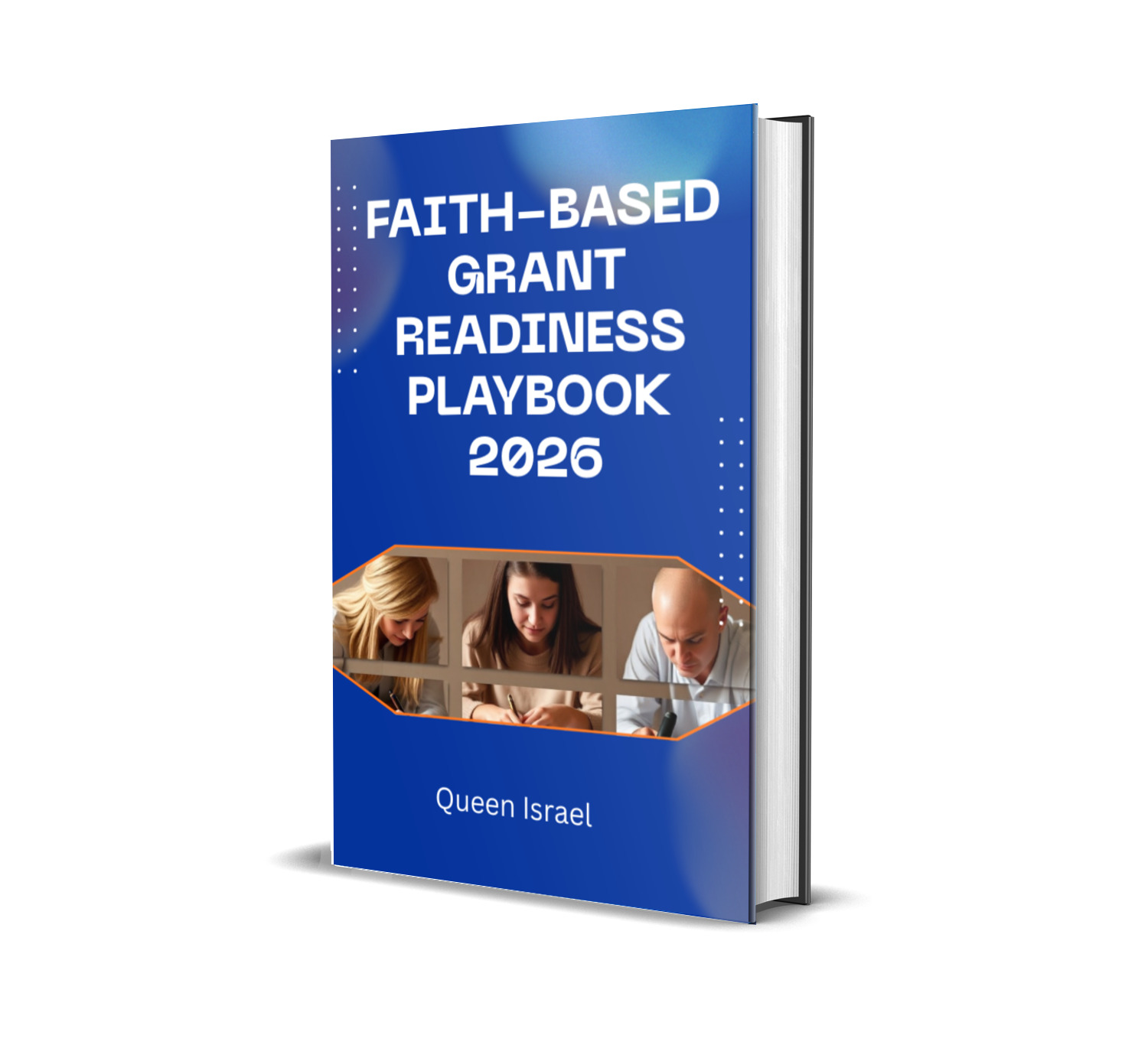
The Faith-Based Grants Readiness Playbook 2026 helps churches and faith-based organizations build the governance, financial systems, policies, programs, budgets, documents, evidence, and internal processes funders expect before considering an application.
GET THE FAITH-BASED GRANTS READINESS PLAYBOOK
How to Prepare a Strong Grant Application From Africa
A strong proposal does not begin with a long emotional story. It begins by confirming that the organization and project are eligible.
Step 1: Read the Official Guidelines
Confirm:
- Eligible countries
- Applicant type
- Program priorities
- Excluded activities
- Funding amount
- Deadline
- Religious restrictions
- Fiscal sponsor requirements
- Currency
- Reporting
- Language
- Submission process
Step 2: Prepare a One-Page Funder Brief
Record:
- Funder name
- Official source
- Program name
- Countries funded
- Applicant types
- Amount
- Deadline
- Open or closed status
- Religious eligibility
- Required partner
- Required documents
- Contact route
- Fit score
- Next action
Step 3: Write a Clear Need Statement
Do not rely only on claims such as:
Our community is very poor.
Explain:
- Where the community is located
- Who is affected
- How many people are affected
- Which evidence is available
- What services already exist
- What gap remains
- Why the proposed project is appropriate
- How the community helped design it
Step 4: Build a Realistic Budget
Include only costs connected to the activities.
Possible budget lines include:
- Personnel
- Training
- Materials
- Transportation
- Venue
- Equipment
- Communication
- Monitoring
- Safeguarding
- Administration
- Audit
- Bank charges
- Currency fluctuation
- Contingency when allowed
Do not conceal the pastor’s personal income inside vague lines such as “ministry support.”
Step 5: Explain Local Accountability
Identify:
- Project manager
- Finance officer
- Board oversight
- Procurement process
- Bank signatories
- Reporting schedule
- Receipt storage
- Monitoring responsibilities
- Complaint mechanism
- Partner roles
Step 6: Prepare Evidence of Past Work
Provide:
- Program records
- Participant numbers
- Photographs with consent
- Testimonials
- Partner letters
- Previous reports
- Financial records
- Monitoring data
- References
- Media coverage where appropriate
Do not fabricate participants, partnerships, or outcomes.
Step 7: Submit Through the Correct Route
The correct route may be:
- Online application
- Letter of inquiry
- Bishop’s office
- Denominational headquarters
- International partner
- Fiscal sponsor
- Fundraising platform
- Invitation
- Donor recommendation
Sending an application to the wrong office can result in immediate rejection.
Documents African Pastors and Ministries Should Prepare
Prepare the documents relevant to the applicant:
- Registration certificate
- Constitution or governing document
- Statement of faith where requested
- Board list
- Leadership biographies
- Organizational chart
- Tax or nonprofit documentation
- Bank confirmation
- Bank statements
- Financial statements
- Annual budget
- Project budget
- Audit or independent review
- Strategic plan
- Annual report
- Program description
- Monitoring framework
- Safeguarding policy
- Child-protection policy
- Conflict-of-interest policy
- Anti-fraud policy
- Procurement policy
- Data-protection policy
- Land or property documents
- Construction estimates
- Vehicle quotation
- Partner letters
- Denominational endorsement
- Bishop’s approval
- Fiscal sponsorship agreement
- References
- Previous grant reports
- Photographs
- SWIFT information
- English translations where required
Get Deeper Faith-Based Funding Guidance
Paid Faith-Based Grants Newsletter subscribers receive deeper funder research, verified funding analysis, application clinics, faith-safe proposal guidance, budget breakdowns, international eligibility lessons, templates, and readiness resources.
UPGRADE TO THE PAID FAITH-BASED GRANTS NEWSLETTER
A 90-Day Funding Plan for Pastors and Ministries in Africa
Days 1–15: Define the Applicant and Project
Complete:
- Identify the legal applicant.
- Confirm registration status.
- Define one project.
- Identify the target population.
- Confirm the location.
- Estimate the total cost.
- Define the amount requested.
- Identify local contribution.
- Confirm whether the project is pastoral or community focused.
- Obtain leadership approval.
Required output: A one-page project concept.
Days 16–30: Organize Governance and Financial Documents
Collect:
- Registration documents
- Constitution
- Board list
- Bank details
- Financial statements
- Annual budget
- Project budget
- Policies
- Previous reports
- Partner references
- Denominational approval
Required output: A complete organizational funding file.
Days 31–45: Build the Project Design
Develop:
- Need statement
- Goal
- Objectives
- Activities
- Timeline
- Outputs
- Outcomes
- Monitoring methods
- Safeguarding plan
- Sustainability strategy
- Risk plan
Required output: A complete project framework.
Days 46–60: Research Funding Pathways
Research:
- Christian foundations
- Catholic funding agencies
- Denominational funds
- International partners
- Microgrants
- Community-development funders
- GlobalGiving
- CAF America eligibility
- Fiscal sponsors
- Corporate partnerships
- Diaspora churches
Required output: A list of 10 qualified prospects, not 100 random funders.
Days 61–75: Build Relationships and Confirm Eligibility
Complete:
- Letters of inquiry
- Introductory emails
- Partner meetings
- Denominational conversations
- Fiscal sponsor discussions
- Funder questions
- Eligibility confirmation
- Document translations
- Due-diligence preparation
Required output: Written confirmation of the most realistic routes.
Days 76–90: Submit the Best-Fit Request
Prepare:
- Customized application
- Project narrative
- Budget
- Budget justification
- Supporting documents
- Authorization
- Final review
- Submission record
- Follow-up date
- Reporting file
Required output: One strong submission or verified partnership request.
Need Help Building an International Faith-Based Funding Pathway?
Grant Writing Academy provides customized faith-based funder research and international grant-strategy support based on your country, legal structure, denomination, project, population, budget, partnerships, documents, and organizational readiness. BOOK AN INTERNATIONAL FAITH-BASED GRANT STRATEGY SESSION
Grant Writing Academy and Faith-Based Grants do not award grants, represent the funders listed, influence funder decisions, or guarantee funding.
Frequently Asked Questions
1. Are there grants that give free money directly to pastors in Africa?
Direct personal grants are uncommon.
Most legitimate programs fund:
- Registered churches
- Dioceses
- Faith-based nonprofits
- Theological institutions
- Community programs
- Approved ministry projects
- Denominational initiatives
Pastors facing personal emergencies should investigate denominational welfare, clergy associations, church networks, retirement programs, local relief funds, and trusted personal fundraising routes.
2. Can an unregistered ministry receive an international grant?
Some microgrant programs accept informal groups, but many institutional funders require legal registration.
An unregistered ministry may need:
- A fiscal sponsor
- A registered church partner
- A denominational applicant
- A legally registered nonprofit partner
GlobalGiving states that unregistered projects generally need to work through a registered fiscal sponsor.
3. Can a United States foundation fund a church in Africa?
Yes, but the foundation may need to follow special international grantmaking procedures.
The funder may use:
- An equivalency determination
- Expenditure responsibility
- A US fiscal sponsor
- An international grantmaking intermediary
- A verified cross-border giving platform
These procedures can require detailed legal, financial, governance, and reporting documents.
4. Do pastors need to pay an application fee for a grant?
Legitimate grantmakers generally do not demand an upfront payment to release a grant.
Be cautious when someone asks for:
- Processing fees
- Tax-clearance payments
- Delivery fees
- Insurance payments
- Account activation payments
- Cryptocurrency
- Mobile-money transfers
- Personal banking passwords
Always verify the opportunity through the organization’s official website and independently published contact details.
5. Can an African church receive funding for evangelism?
Some Christian and Catholic funders support evangelism, discipleship, pastoral training, church planting, theological education, media, or church infrastructure.
Other funders prohibit evangelism, proselytizing, compulsory religious participation, or discrimination.
For example, Aid to the Church in Need specifically supports eligible Catholic pastoral and evangelization projects, while The Pollination Project does not support projects or groups seeking to proselytize or evangelize.
The organization must match its project to the correct funder.
Conclusion
The biggest mistake pastors make when searching for free grants in Africa is assuming that ministry status is enough to establish eligibility.
International funding normally follows a structure.
The pastor may need a registered church, nonprofit organization, diocese, denomination, theological institution, fiscal sponsor, international partner, or verified fundraising platform. T
he project must be specific.
The budget must be transparent.
The board must exercise oversight.
The bank account must belong to the applicant.
The organization must be able to document results and report how every grant dollar was used.
Do not begin by sending the same emotional request to hundreds of funders.
Begin by choosing one fundable project, organizing the required documents, confirming the correct applicant, and identifying ten prospects whose eligibility rules genuinely match your organization.
Build Your Faith-Based Funding Strategy With Year-Round Support
The Faith-Based Grants Founding Membership is designed for faith-based organization leaders, pastors, grant writers, program directors, board members, consultants, and outreach teams that need continuing support with grant readiness, funder research, program development, proposal writing, budgets, application review, and sustainable funding strategy.
Members receive practical resources, strategic guidance, coaching support, and accountability throughout the year.
EXPLORE THE FAITH-BASED GRANTS FOUNDING MEMBERSHIP



Greeat wrblog righ here! Addiionally youur ssite qite a
biit uup very fast! Whhat wweb host are youu using?
Can I amm gettinhg ykur associate linnk on yoir host?
I want myy web site losded upp as fast ass
your lol xnxx
I want to apply for a free grant for African pastors. Kindly send an email address to use