
A foundation can describe its interests in four broad words and still spend most of its grant budget in a much narrower way.
“Education” might appear prominently on its website. Yet three years of actual awards may show that the foundation rarely funds education in the broad sense.
It could be that most of its education dollars go to college-access programs for first-generation students.
Perhaps almost every recipient operates in two counties or grants above $75,000 go almost exclusively to organizations that have already received funding from the foundation.
Maybe first-time grantees usually enter with awards between $10,000 and $25,000.
Those details change the prospecting question.
Instead of asking only, “Does this foundation fund education?”, a stronger researcher begins asking, “What kind of education does it repeatedly fund, where does it fund it, who receives the money, how much do new grantees receive, and is that pattern changing?”
Consider a fictional grantmaker called the North Harbor Community Foundation. Its website says it supports:
- Youth development
- Education
- Workforce development
- Community wellbeing
On the surface, a nonprofit providing employment training to unemployed adults might appear to be an excellent fit.
But a review of three years of grants reveals something more specific:
- 62% of education-related awards supported after-school programs or college access.
- Almost 70% of all grants went to organizations operating in two counties.
- Grants of $75,000 or more usually went to organizations the foundation had funded before.
- Most first-time grantees received between $10,000 and $25,000.
- Workforce grants increasingly supported young adults ages 18–24 rather than the general adult population.
- Several older adult-employment programs disappeared from the most recent grant list.
The adult workforce nonprofit has not suddenly become ineligible. But its prospect rating should probably change.
A youth employment organization in one of the foundation’s priority counties may deserve a GO decision. A general adult workforce organization outside those counties may deserve a WATCH, CULTIVATE, or even REMOVE decision unless other current information points in a different direction.
That is the difference between collecting foundation names and conducting serious nonprofit foundation prospect research.
A foundation’s published priorities tell you how the grantmaker describes its work. Its foundation grant history gives you evidence of how that mission has been translated into actual funding decisions.
Neither source should be used alone.
And neither allows you to predict a future award with certainty.
But when historical giving is examined carefully alongside current guidelines, announcements, leadership, strategy, geography, and recent initiatives, it can give you a much stronger basis for deciding where your limited grant-writing time belongs.
A Foundation’s Grant History Can Tell You More Than Its Funding Priorities Page
A foundation website should usually be one of your first research stops, but it should rarely be your final prospect-qualification tool.
Published priorities are important because they explain what the foundation says it wants to accomplish. They may define eligibility, geographic limitations, application procedures, exclusions, focus areas, populations, deadlines, and current initiatives.
The problem is that a published category can be much broader than the foundation’s actual giving behavior.
Suppose the Bright Fields Foundation lists education as one of four major priorities.
A grant writer might search the website, see education, confirm that nonprofits are eligible, and immediately add the foundation to an education prospect list.
Then the researcher examines the foundation’s last 40 education-related grants.
The awards reveal:
- 14 grants for K–5 literacy
- 10 grants for first-generation college access
- 8 grants for teacher professional development
- 4 grants for school-family engagement
- 2 grants for special education support
- 1 educational technology grant
- 1 adult education grant
- No school-construction grants
- No general scholarship programs
Now “education” means something much more useful.
The foundation is not simply an education funder. Its historical giving suggests a stronger pattern around early literacy, college access, teacher capacity, and student support.
That distinction matters.
An adult literacy nonprofit technically fits the published priority. But based on the evidence available, it may be a weaker prospect than a K–5 reading intervention operating in the foundation’s preferred geography.
This is why learning how to analyze a foundation’s past grants requires more than scanning recipient names.
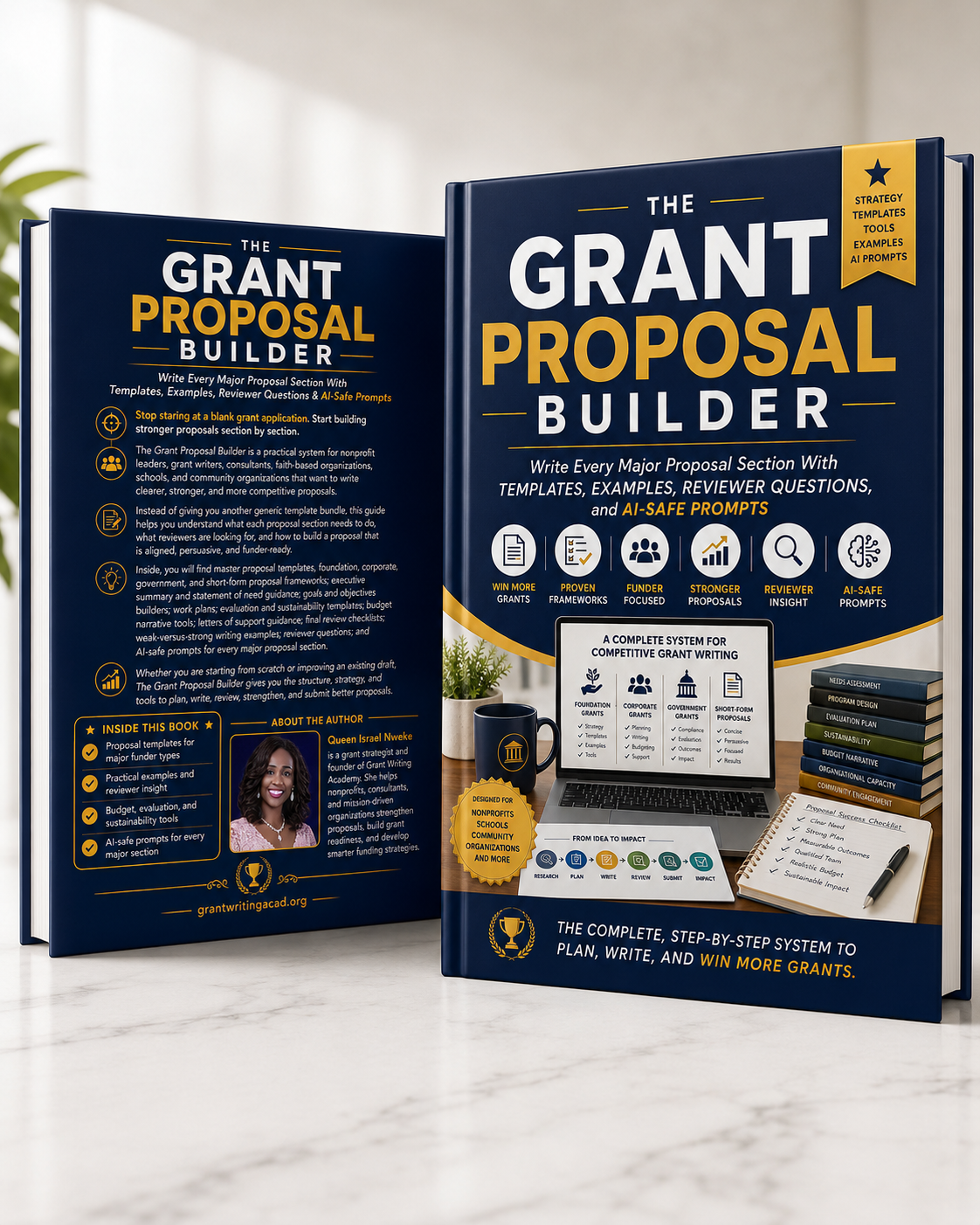
Tired of Rejection? Pre-order The Grant Proposal Builder Today @$39.99. Offer ends Sept. 14th, 2026
Read a grant list as evidence of behavior
For every serious foundation prospect, begin asking:
- What has the foundation actually funded during the last three to five years?
- Which program models appear repeatedly?
- Which populations appear repeatedly?
- Which published priorities receive substantial funding, and which receive very little?
- Where are funded organizations located?
- Does the foundation repeatedly support the same recipients?
- How frequently do new grantees appear?
- What kinds of requests receive funding—programs, general operations, capital, research, capacity building, equipment, advocacy, or something else?
- What grant amounts appear repeatedly?
- Has the pattern changed in the most recent year or two?
The last question is especially important.
Historical grantmaking is not static.
A foundation that strongly supported food security four years ago may now be shifting toward community health. A corporate foundation may expand funding into cities where its parent company has opened new facilities. A family foundation may begin supporting a new issue after leadership passes to another generation. A community foundation may launch a time-limited initiative that temporarily changes what appears in its grant history.
That is why the objective is not to conclude:
“They funded this before, so they will fund us.”
The better conclusion is:
“Their recent behavior provides evidence that makes this opportunity stronger, weaker, or uncertain for our organization.”
Separate five different pieces of evidence
Strong foundation grant research separates information that inexperienced researchers often mix together.
a) Stated funding interests are the causes and themes the foundation publicly identifies.
b) Actual historical giving shows where money has gone.
c) Current strategic priorities tell you what leadership appears to be emphasizing now.
d) Geographic eligibility tells you where the foundation is willing to consider applicants.
e) Actual geographic behavior tells you where its grants are heavily concentrated.
These can overlap, but they do not always match perfectly.
A foundation may state that it accepts applications statewide while awarding 85% of its grants within three metropolitan areas.
That does not automatically mean organizations elsewhere are ineligible. It does mean the geographic concentration deserves investigation before you invest heavily in a proposal.
The same rule applies to award amounts.
A foundation might advertise grants “up to $100,000.” That does not mean $100,000 is the normal request for a new applicant.
If its past grants show that first-time organizations usually receive $15,000–$30,000 while $75,000–$100,000 grants go to long-term partners, the historical pattern should influence your request strategy.
Use multiple sources, not a single database
When researching past grants awarded by foundations, compare what you find across several sources whenever possible:
- The foundation’s website
- Current funding guidelines
- Annual reports
- Grant announcements
- Press releases
- Recipient websites
- Foundation grant databases
- Public tax filings for private foundations
- News about new strategies or initiatives
- Leadership announcements
- Recent strategic plans
For U.S. private foundations, Form 990-PF can be especially useful. One important technical distinction is worth knowing: grant-recipient information on Form 990-PF is generally reported in Part XIV, Supplementary Information, rather than Schedule I. Current IRS instructions require Part XIV to report grants actually paid during the year and grants approved for future payment, including information such as recipient, amount, and grant purpose.
For prospect research, you are usually looking for practical information rather than trying to become a tax expert:
- Who received grants?
- Where were recipients located?
- How much did they receive?
- What was the stated purpose?
- Which recipients appear repeatedly?
- Which purposes appear repeatedly?
- Which commitments appear to continue into future periods?
Grant datasets can also help researchers organize recipient, grant-purpose, geography, and funding-pattern information at scale. Candid, for example, describes grant data that includes funding transactions, recipients, purpose, geography, and other classification information.
But tax filings have an important limitation: they describe historical activity and can lag behind what a foundation is doing today.
A 990-PF should therefore be evidence, not your entire prediction model.
The deeper question remains:
What does the combination of historical behavior and current information tell us about this prospect now?
Want the Full Foundation Grant Analysis Framework?
Knowing that past awards matter is only the first layer of serious foundation research.
The greater advantage comes from knowing which patterns deserve the most weight, how many years to compare, how to distinguish meaningful trends from isolated grants, how to analyze repeat versus new grantees, how to estimate a defensible request range, and how to recognize when a foundation’s funding direction may be changing before the change is fully reflected on its website.
The remainder of this premium guide walks through the complete analysis process, including the eight funding signals to measure, a three-part method for evaluating future direction, a GO / CULTIVATE / WATCH / REMOVE qualification system, realistic multi-year examples, and a reusable Foundation Funding Intelligence File.
Upgrade to Grant Writing Academy Annual to Continue Reading
Grant Writing Academy Annual subscribers receive continued access to the premium article library, advanced prospect-research strategies, proposal guidance, funding intelligence, practical frameworks, templates, and deeper training designed to help you approach grant opportunities with stronger information and better strategic judgment.
Upgrade to Grant Writing Academy Annual to unlock the complete guide and continue reading.
— ANNUAL SUBSCRIBER CONTENT CONTINUES BELOW —