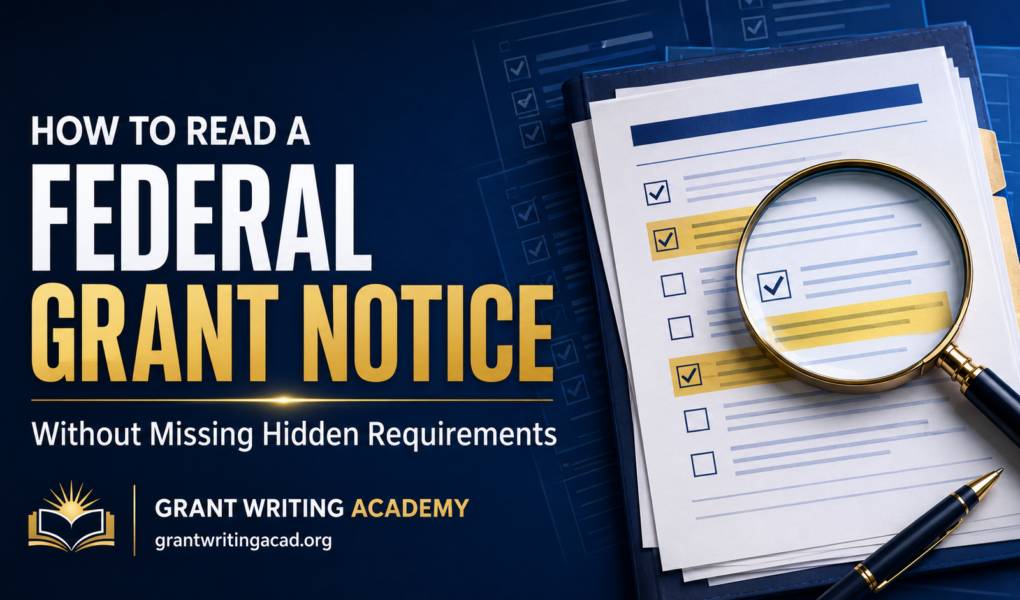
A federal grant application can fail before a reviewer evaluates the strength of the proposed program. The applicant may describe a serious community problem, present an experienced project team and develop activities capable of producing meaningful results, yet still lose consideration because one required attachment was omitted, an eligibility condition was misunderstood or a page limit was exceeded.
Federal funding notices do not place every important instruction in one convenient section. A requirement mentioned briefly under eligibility may affect the entire application. A sentence under award administration may introduce a reporting responsibility that changes the project budget. An instruction buried in the application-submission section may require a document that is not included in the main proposal narrative.
This is why applicants should not treat a federal Notice of Funding Opportunity, commonly called a NOFO, as promotional information about a grant. It is the funder’s controlling set of application instructions. It explains who may apply, what the funding may support, how the application must be assembled, how reviewers will score it and what the recipient will be expected to do if an award is made.
Learning how to read a federal grant notice carefully is therefore one of the most important federal grant-writing skills. It helps an organization avoid spending weeks preparing an application for which it is ineligible. It also allows the grant team to identify risks, documents, partnerships and internal decisions before the submission deadline becomes an emergency.
Why Federal Grant Requirements Are Easy to Miss
Federal grant notices are often long because they must communicate several kinds of information to different readers. The executive director may be most interested in eligibility and funding amounts. The program manager may concentrate on allowable activities. The finance team may look for cost-sharing requirements and budget restrictions. The grant writer may focus on the narrative sections and evaluation criteria.
The danger is that every team member may read only the section that appears relevant to their role. Important requirements can then fall between those responsibilities.
For example, the program team may design an excellent training project without noticing that the grant restricts the age or geographic location of eligible participants. The grant writer may prepare the complete narrative before discovering that the applicant needs a formal agreement with a government agency. The finance officer may develop the budget without realizing that indirect costs are limited or that certain expenses require prior approval.
Federal grant notices also use words that appear similar but carry different consequences. An activity that is allowed is not necessarily an activity the agency considers a priority. An organization that is generally eligible may still need to satisfy additional requirements connected to a particular funding category. A recommended attachment may strengthen an application, while a required attachment may determine whether the application is reviewed at all.
Applicants should therefore look for words such as:
- Must
- Required
- Shall
- May
- Should
- Eligible
- Ineligible
- Allowable
- Unallowable
- Limitation
- Priority
- Preference
- Waiver
- Threshold
- Responsiveness
- Cost sharing
- Matching requirement
Every occurrence of these words deserves attention because it may create an application obligation or affect how the proposal is evaluated.
The Five Questions to Answer Before Writing Anything
Before drafting the proposal, the grant team should be able to answer five basic questions.
1. Is the organization eligible?
Do not assume that nonprofit status automatically creates eligibility. A federal funding opportunity may be limited to state governments, local governments, tribal entities, institutions of higher education, specific nonprofit categories or organizations operating in defined geographic areas.
Confirm:
- The eligible applicant types
- Required legal or tax status
- Geographic limitations
- Registration requirements
- Experience or operational requirements
- Whether partnerships are compulsory
- Whether an organization may apply independently
- Whether the organization can submit more than one application
If the language is unclear, use the official contact information provided in the notice to request clarification. Do not base an expensive application on an assumption.
2. Does the proposed project fit the purpose of the grant?
A project can be valuable and still be wrong for a particular funding opportunity. Compare the organization’s proposed activities with the stated program purpose, statutory authority, funding priorities and expected results.
Ask whether the project serves the correct population, addresses the identified problem and uses approaches the agency is authorized to fund.
3. Can the organization meet the operational requirements?
Eligibility answers whether the organization is permitted to apply. Capacity answers whether it can realistically perform the work.
Consider whether the organization can manage the award amount, collect the required data, comply with reporting obligations, supervise partners and maintain appropriate financial controls.
4. Can the complete application be prepared on time?
Check the submission deadline, time zone, registration requirements, required attachments, partner commitments and internal approval process. Some registrations or supporting documents may take longer to secure than the proposal takes to write.
5. Is pursuing the opportunity strategically sensible?
Estimate the effort, cost, competition, award size, restrictions and long-term responsibilities. The fact that an organization can apply does not always mean that it should apply.
At this point, free readers understand why a federal NOFO requires more than a quick reading. The premium section below provides the complete line-by-line review method, requirement-extraction system, practical example and final NOFO analysis checklist.
CONTINUE READING WITH GRANT WRITING ACADEMY
You have completed the free preview.
The premium section contains the complete federal NOFO review method, a requirement-extraction system, a practical application example and a final compliance checklist.
Join the Grant Writing Academy Annual Membership for $100 per year to continue reading and access premium articles, templates, checklists and practical resources covering federal, foundation and corporate grants.
UPGRADE TO GRANT WRITING ACADEMY — $100/YEAR
Already an annual member? Log in to continue reading.
UPGRADE TO GRANT WRITING ACADEMY
Already an annual member? Log in to continue reading.