If your nonprofit has spent the year submitting grant applications and receiving rejection after rejection, the next step should not automatically be finding another ten grants and sending out slightly modified versions of the same proposal.
At some point, the strategy itself has to be examined.
Many organizations respond to unsuccessful grant applications by increasing volume. They search harder, subscribe to more grant databases, download more application forms, reuse previously written narratives, change the funder’s name, adjust a few paragraphs, and submit again. When another rejection arrives, they repeat the same process because they assume that eventually one funder will say yes.
But more applications do not automatically create stronger applications.
If the same weaknesses are being carried from proposal to proposal, submitting more frequently may simply multiply the number of times those weaknesses are presented to funders.
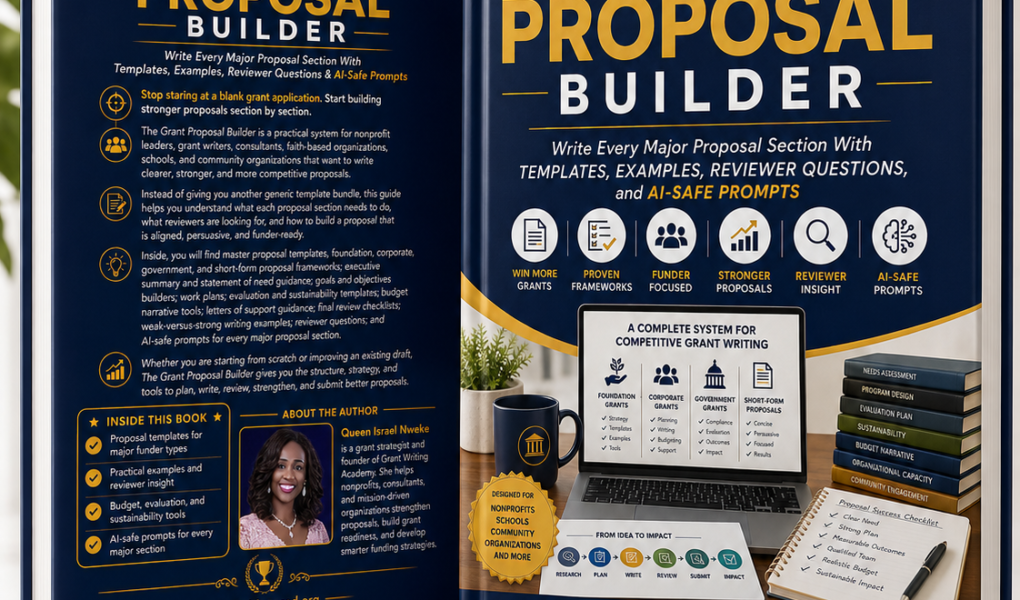
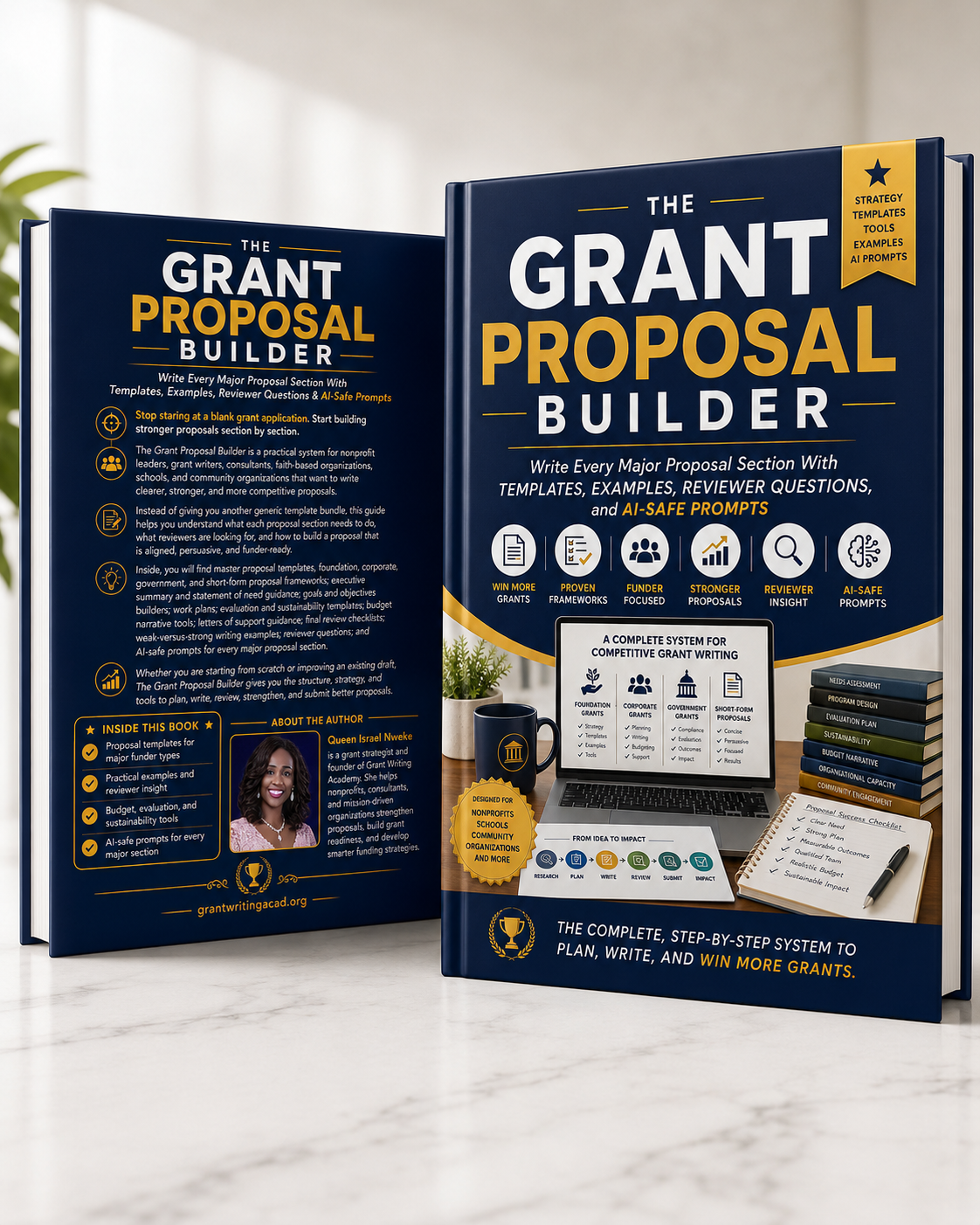
This is one of the most important reasons I created The Grant Proposal Builder: Write Every Major Proposal Section With Templates, Examples, Reviewer Questions, and AI-Safe Prompts.
With another major grant-planning period approaching in October, September should not become a month of waiting. It should become a month of preparation.
This is the time for nonprofit organizations to pull out previously submitted proposals, examine where their grant-development process may be breaking down, train the people who contribute to applications, organize evidence and program information, reconcile budgets, clarify outcomes, confirm partner roles, and strengthen the internal systems that will support upcoming grant applications.
The Grant Proposal Builder officially releases September 14, 2026. The pre-order price is $39.99, compared with the regular price of $97 after release.
The purpose is much more practical: to help organizations stop repeatedly submitting weak, inconsistent, underdeveloped, or poorly aligned proposals when there are identifiable problems they can address before the next application deadline arrives.
Why Repeated Grant Rejections Should Trigger a Strategy Review
Receiving one grant rejection does not necessarily mean your proposal was poor.
Funders decline strong applications all the time because available funding is limited, competition is intense, geographic priorities change, program portfolios shift, or another applicant simply aligns more closely with what the funder is trying to accomplish.
However, when an organization experiences repeated grant rejection across multiple funders and application cycles, it becomes increasingly important to examine the pattern.
The question should no longer be only:
“Where can we find another grant?”
The stronger question becomes:
“What should we improve before we submit another grant?”
That distinction can completely change an organization’s grant strategy.
Start with opportunity selection.
Your nonprofit may be technically eligible for many funding opportunities without being highly competitive for them. Eligibility simply means you are permitted to apply. Competitive alignment requires much more.
The funder may prioritize a population you serve only indirectly. Your program may fall broadly within its interests but not within the specific activities it currently wants to support. Your organization may operate in an eligible geography but have limited evidence of impact in the communities the funder prioritizes. The award may also require implementation capacity, partnerships, reporting systems, or financial infrastructure your organization does not yet have.
If you repeatedly pursue grants primarily because the funding amount is attractive, you may spend enormous amounts of staff time writing proposals that had a weak strategic fit from the beginning.
Then examine the proposal itself.
Does your Statement of Need establish a precise problem, or does it simply list statistics?
There is an important difference.
Saying that 30 percent of households in a community experience a particular economic challenge may demonstrate that a problem exists, but it does not automatically explain why your proposed program is the appropriate response.
A strong Statement of Need must move the reader from the broader condition to the specific gap your organization intends to address.
The same scrutiny should be applied to the Program Description.
If your proposal says your nonprofit will “empower underserved youth through comprehensive support services,” a reviewer may still know almost nothing about how the program works.
- How are young people recruited?
- What happens at enrollment?
- What assessment is completed?
- How many sessions will participants receive?
- Who delivers the services?
- What qualifications will staff have?
- What happens if participants stop attending?
- How do partner organizations contribute?
- How long does someone remain in the program?
- What does program completion actually mean?
The more operationally specific your program becomes, the easier it is for a funder to understand what its money would actually support.
Repeated rejection should therefore create a learning process.
Do not simply change the funder.
Examine the strategy.
Stop Submitting the Same Rejected Grant Proposal and Expecting a Different Result
One of the easiest habits to develop in grant writing is proposal recycling.
Reusing strong organizational information is not inherently a problem. In fact, nonprofits should maintain verified, reusable information on organizational history, programs, leadership, target populations, past performance, financial systems, partnerships, and other frequently requested subjects.
The problem begins when reuse becomes automatic.
A proposal that was written for one foundation should not simply be copied into another application because both funders support “community development.”
A corporate funder may evaluate the project differently from a private foundation.
A government agency may require significantly more implementation, compliance, staffing, financial, performance, and risk detail than a foundation proposal.
Even two foundations working in the same issue area can have very different priorities.
More importantly, a proposal that has been rejected repeatedly should not become an untouchable organizational document.
Open it again.
Interrogate it.
Ask difficult questions.
If the same Statement of Need has appeared in eight proposals, is the evidence still current?
If the same outcome has appeared for two years, is there evidence your program can actually achieve it?
If the same sustainability paragraph has been copied into every application, does it describe a real sustainability strategy or simply say your organization will pursue additional grants and donors?
If your participant target is always 300 people, is that number based on capacity or habit?
If the same partner is listed in every proposal, what exactly is that organization currently committed to providing?
If your budget repeatedly requests similar personnel costs, have you examined whether staff time is aligned with the workload described in the narrative?
This is the type of proposal diagnosis that should happen before another major funding cycle begins.
A previous proposal should become a source of intelligence.
- What did you learn while writing it?
- What questions were difficult to answer?
- Where did staff disagree?
- What information had to be chased at the last minute?
- Which attachments were difficult to locate?
- Which numbers changed during the application?
- Which claims could not be properly verified?
- Where did finance and program staff have different assumptions?
Those problems often tell you far more about your grant readiness than the polished final PDF ever will.
The Grant Proposal Builder was developed to help organizations work through these underlying questions instead of treating grant writing as a process of endlessly producing new narrative.
The goal is not to make rejection disappear.
The goal is to make sure your organization is not carrying avoidable weaknesses into the next application.
Pre-order Today. Offer ends 14th September, 2026
Use September to Train Your Nonprofit Team Before Grant Opportunities Accelerate
One of the biggest misconceptions about grant writing is that the grant writer is solely responsible for the quality of the application.
A grant writer can structure information, strengthen clarity, research funders, develop narratives, organize evidence, connect proposal sections, and manage deadlines.
But the grant writer cannot responsibly invent organizational reality.
Program staff must understand the service model.
Finance must understand and approve the budget.
Leadership must make organizational decisions.
Evaluation staff must understand how outcomes will be measured.
Partners must confirm their responsibilities.
The proposal is where all of those decisions become visible.
That is why nonprofit team training before an active grant cycle can make such a significant difference.
Instead of waiting until a funding opportunity opens, use the preparation period to bring the people involved in grant development together.
Your Executive Director should understand what organizational capacity claims the proposal makes.
Your Program Director should understand why activity details, participant flow, staffing ratios, implementation timelines, and service frequency matter.
Your Finance Team should understand that the grant budget cannot be developed independently from the program narrative.
Your Evaluation Team should understand which indicators will be needed and whether the organization can realistically collect them.
Your partners should understand that being named in a proposal may require specific commitments rather than a generic letter stating that they support your organization.
And your grant writer should have a structured system for collecting all of that information.
This is one of the ways The Grant Proposal Builder can be used beyond individual reading.
It can become a team-development resource.
The book includes tools for proposal planning, team interviews, internal information gathering, evidence verification, reviewer questions, budget review, proposal diagnostics, quality control, and final proposal review.
Imagine beginning October with your team already able to answer questions such as:
- What are our priority programs for grant funding?
- What does each program actually cost?
- How many participants can we realistically serve?
- Which outcomes do we currently track?
- Which outcomes would require new data systems?
- What evidence supports our Statement of Need?
- What documents are current?
- Which partnerships are active?
- Which partner commitments are confirmed?
- What funding restrictions can we accommodate?
- What is our realistic minimum budget?
- Which program elements could continue if a grant ended?
- What information still requires leadership approval?
Those answers dramatically reduce the chaos that often occurs when a strong opportunity appears with a short deadline.
Instead of spending the first week figuring out what the program actually is, your team can spend more time determining how to present an already-developed project effectively to the funder.
Why The Grant Proposal Builder Goes Beyond Blank Grant Templates
There are many grant proposal templates available online.
Most tell you which sections to write.
Far fewer help you understand what each section must actually prove.
That difference matters.
The Grant Proposal Builder is designed as a proposal-development system rather than simply a template collection.
It covers major components of foundation, corporate, government, and short-form grant applications, including:
- Funding opportunity analysis
- Proposal strategy and planning
- Executive summaries
- Statements of need
- Program descriptions
- Goals and objectives
- Work plans and implementation
- Evaluation and performance measurement
- Sustainability
- Organizational capacity
- Equity, accessibility, and community engagement
- Budgets and budget narratives
- Partnerships and letters of support
- Supporting documents
- Reviewer questions
- Proposal diagnostics
- Weak-versus-strong grant writing
- Proposal review and revision
- Reviewer simulation
- Submission and recordkeeping
- AI-safe grant writing
The Builder also includes detailed fictional foundation, corporate, and government grant proposal examples.
These examples are important because grant writers are frequently told to “add more detail” without being shown what meaningful detail looks like.
There is a difference between writing:
“Our organization will provide job-readiness training to underserved young adults.”
and explaining how young adults are recruited, screened, assessed, enrolled, trained, supported, connected to employers, followed after placement, and tracked throughout the process.
Specificity creates operational credibility.
The book also contains practical resources that can be reused during real applications, including a Master Grant Proposal Builder Toolkit, a copy-and-paste AI Prompt Vault, a Quick-Reference Library, a Team Meeting and Interview Question Bank, a Master Templates Pack, a detailed Proposal Quality-Control Workbook, and a Proposal Evidence and Source Verification System.
The evidence-verification component is especially important as more organizations use AI.
Artificial intelligence can help grant writers organize information, strengthen clarity, identify inconsistencies, compare sections, analyze requirements, simulate reviewer questions, and diagnose weak areas.
But AI can also confidently create information that has never been verified.
A statistic can sound credible and still be wrong.
A citation can appear legitimate and still not exist.
A partner commitment can sound convincing even though the partner never made it.
An organizational accomplishment can be exaggerated.
A budget assumption can be converted into a polished paragraph without finance ever approving the number.
That is why one of the principles throughout The Grant Proposal Builder is simple:
Do not guess. Identify what still needs to be verified.
AI should help organizations think more critically.
It should not be allowed to create the facts underneath the proposal.
How to Build a Stronger Grant Proposal Strategy for the Next Funding Cycle
If your nonprofit plans to pursue grants beginning in October and throughout the remainder of the year, your preparation should begin before the first exciting funding announcement appears.
Choose several previously submitted proposals and conduct a serious review.
Do not read them only for grammar.
Read them for credibility.
- Does every number match?
- Does the budget support the activities?
- Does the staffing make sense?
- Can you follow the participant journey?
- Are the outcomes realistic?
- Can those outcomes actually be measured?
- Is every major claim supported?
- Are partner responsibilities clear?
Does the sustainability strategy explain continuation rather than simply promising additional fundraising?
Then look beyond the proposal itself.
Review your internal process.
- How long does it normally take your team to approve a project?
- Who has final authority over participant targets?
- Who approves salaries and fringe assumptions?
- Who verifies statistics?
- Who communicates with partners?
- Who owns the evaluation plan?
- Who approves the final narrative?
- Who uploads the application?
- Where are supporting documents stored?
If these responsibilities are unclear, fix them before deadlines become urgent.
Next, build a reusable proposal information system.
Create current organizational descriptions.
Maintain verified program information.
Keep updated staff biographies.
Organize evidence sources.
Maintain accurate participant data.
Document active partnerships.
Keep financial information accessible.
Track previous proposals and funder decisions.
Record questions that repeatedly create delays.
Then, when a new grant opportunity appears, you are not rebuilding your organization from memory.
You are customizing from verified information.
That is a very different grant-writing process.
And it is one of the core ideas behind The Grant Proposal Builder.
PRE-ORDER THE GRANT PROPOSAL BUILDER BEFORE THE NEXT GRANT CYCLE
If your nonprofit has been experiencing repeated grant rejections, do not enter the next funding cycle automatically submitting the same proposals, using the same process, and expecting the result to change simply because the funder is different.
Use this preparation period differently.
Review what has not been working.
Train your team.
Strengthen your program descriptions.
Verify your evidence.
Reconcile your budgets.
Clarify your outcomes.
Confirm your partnerships.
Improve your internal grant-development process.
Then approach upcoming opportunities with a stronger strategy.
The Grant Proposal Builder officially releases September 14, 2026.
Pre-Order Price: $39.99
Regular Price After Release: $97
Pre-order customers will receive the completed book by email when it is released, giving your organization time to begin using the system before the next active grant cycle.
👉 PRE-ORDER THE GRANT PROPOSAL BUILDER:
Your next grant application should not simply be another version of the last rejected proposal.
It should reflect what your organization learned.
It should reflect stronger preparation.
It should reflect better alignment.
And it should reflect a grant-development strategy your organization is genuinely prepared to improve.
Frequently Asked Questions About The Grant Proposal Builder
1. Who is The Grant Proposal Builder designed for?
The book is designed for nonprofit leaders, grant writers, grant consultants, program managers, development professionals, and organizations that want a more structured approach to developing foundation, corporate, and government grant proposals. It can support newer grant writers while also providing deeper diagnostic, review, evidence, budget, and AI tools for experienced professionals.
2. Can The Grant Proposal Builder help a nonprofit that has received repeated grant rejections?
It is designed to help organizations examine the proposal-development factors they can control, including opportunity fit, project clarity, evidence, internal consistency, program design, budget alignment, evaluation, partner responsibilities, and final review. It cannot guarantee a funding decision, but it can help organizations stop repeating avoidable proposal weaknesses.
3. Does the book contain real grant proposal examples?
The book includes detailed fictional foundation, corporate, and government proposal examples designed specifically for instruction. The examples demonstrate how major proposal sections can connect without exposing confidential information from real applicants.
4. Does The Grant Proposal Builder include AI prompts for grant writing?
Yes. The Builder includes AI-safe prompts designed to support planning, analysis, drafting, revision, consistency checks, evidence review, reviewer simulation, and other grant-development activities while emphasizing verification and avoiding invented organizational facts.
5. When will pre-order customers receive the book?
The Grant Proposal Builder releases September 14, 2026. Customers who purchase during the pre-order period will receive the completed book by email upon release. The current pre-order price is $39.99, while the regular price after release will be $97.
Final Thought: Do Not Carry the Same Grant Strategy Into a New Funding Cycle
There is no responsible way to guarantee that your next grant proposal will be funded.
But there is absolutely a responsible way to make sure you do not keep repeating the same mistakes.
If previous proposals were rejected, learn from them.
If the team was disorganized, fix the process.
If the budget and narrative conflicted, bring finance and program staff together.
If your program description was vague, make the implementation clearer.
If your evidence was weak, strengthen the research.
If AI has been filling organizational gaps, introduce verification controls.
If you were applying for every grant you appeared eligible for, become more strategic about fit.
A new grant cycle should not simply mean new funders.
It should also mean a stronger version of your organization’s grant-development strategy.
That is the purpose of The Grant Proposal Builder.
Prepare before the deadline pressure begins.
Train the people who contribute to your applications.
Review what has already been rejected.
Strengthen what can be strengthened.
And give your next proposal a better foundation than the one that came before it.
🔥 Pre-Order The Grant Proposal Builder for $39.99
Release Date: September 14, 2026
Pre-Order Price: $39.99
Regular Price: $97
Stop starting every grant proposal from scratch, and stop carrying the same weaknesses into every new application. Build a stronger proposal-development system before the next funding cycle begins.