
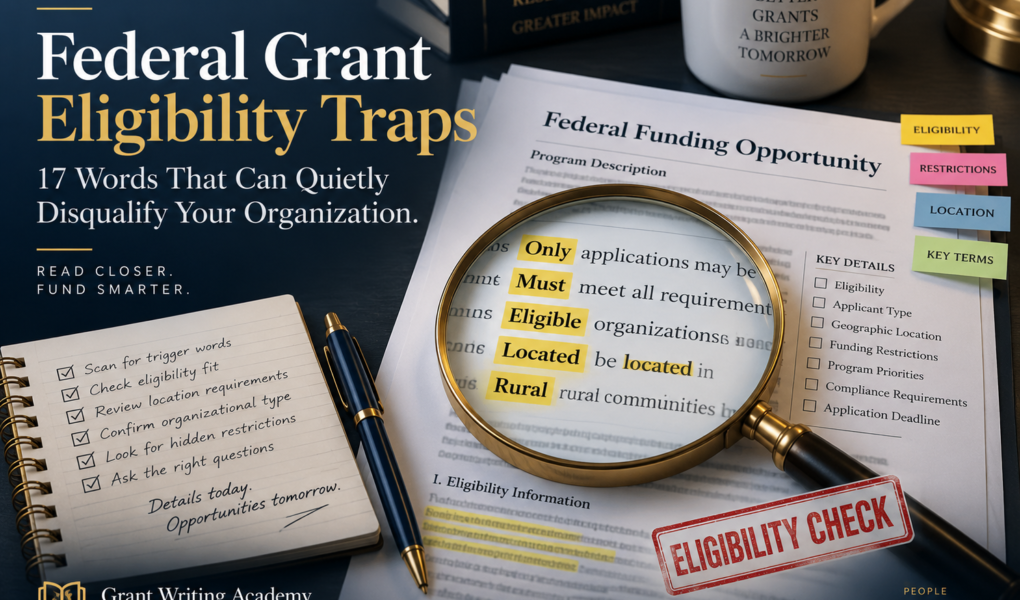
Only. Must. Domestic. Rural. Accredited. Eligible. Located.
None of these words looks especially dangerous.
They can disappear inside a federal Notice of Funding Opportunity containing dozens of pages of program descriptions, priorities, definitions, application instructions, budget rules, attachments, assurances, and submission requirements.
Yet a single qualifier can change the meaning of an entire federal grant opportunity because it can determine who is legally permitted to compete, where the applicant must operate, what status the applicant must hold, which population must be served, or what conditions must already be satisfied.
Consider the difference between these two statements:
- Organizations serving residents of designated rural counties may apply.
- Organizations located within designated rural counties may apply.
Those sentences are not interchangeable.
An organization headquartered in a large metropolitan area might run an excellent rural workforce program and serve hundreds of residents in an eligible rural county. If the Notice of Funding Opportunity requires the applicant itself to be located within the eligible area, serving that area may not satisfy the condition.
That is why serious federal grant research requires more than matching your mission to a program description.
It requires learning to recognize eligibility trigger words: ordinary-looking words and phrases that should make you stop, examine the entire sentence, locate the controlling definition, identify the condition being imposed, and determine whether your organization can prove that it satisfies it.
The federal government itself warns applicants to determine eligibility before applying. Grants.gov explains that each federal Notice of Funding Opportunity defines the eligibility requirements for that particular competition. The broad applicant categories shown on Grants.gov—such as nonprofits, governments, educational institutions, small businesses, and other entities—do not by themselves establish eligibility for every opportunity within that category.
That distinction is the foundation of effective federal grant eligibility screening.
You should not ask only:
“Does this grant fund the type of work we do?”
You should also ask:
“What exact language establishes that our exact legal entity is permitted to submit this application?”
Why Federal Grant Eligibility Is Often Hidden in Ordinary Words
One of the easiest federal grant eligibility mistakes to make is confusing program alignment with applicant eligibility.
Program alignment asks whether the proposed work fits the purpose of the funding opportunity. Applicant eligibility asks whether the organization submitting the application belongs to a category the federal agency is legally or programmatically permitted to fund under that competition.
Those are separate questions.
A youth organization may have exactly the kind of violence-prevention program described in a federal funding announcement, but the opportunity may limit lead applicants to units of local government.
A community nonprofit may operate an excellent health initiative in rural areas, but the NOFO may require applicants to meet a particular definition of a rural entity, rural location, or eligible service area.
A university researcher may propose work that perfectly addresses the program’s research priorities, while the funding announcement limits applicants to accredited institutions that satisfy additional institutional conditions.
This is why a strong federal grant eligibility checklist must test several layers of eligibility instead of producing a single yes-or-no answer too early.
- Program alignment asks whether the proposed idea addresses what the federal program intends to accomplish.
- Applicant eligibility asks whether the legal entity submitting the application is permitted to compete.
- Project eligibility asks whether the proposed activities are allowable under the particular opportunity.
- Geographic eligibility examines where the applicant, project, facility, service area, or beneficiaries must be located.
- Population eligibility examines whether the people the project intends to serve meet the specific population requirements established by the program.
- Organizational eligibility examines characteristics such as nonprofit status, government type, educational status, institutional category, licensing, accreditation, or another required designation.
- Administrative eligibility can involve registrations, submission requirements, certifications, or other conditions needed to participate in the application process. Administrative problems should not automatically be described as statutory applicant ineligibility; the precise consequence depends on the requirement and the NOFO.
- Partnership eligibility asks whether the applicant may apply independently or whether a consortium, lead institution, government partner, fiscal arrangement, or other organizational relationship is required.
A federal grant researcher therefore needs to read funding announcements differently from someone who is simply searching for grants.
The inexperienced reader often scans for subjects:
- Housing
- Mental health
- Workforce development
- Food security
- Youth
- Economic development
- Education
The experienced reader also scans for qualifiers:
- only
- must
- required
- located
- serving
- eligible
- domestic
- nonprofit
- accredited
- licensed
These words are not automatically disqualifying. They are signals telling you to investigate further.
Take the phrase:
“Organizations serving rural communities.”
A researcher should immediately ask how the program defines a rural community, whether the applicant must serve a minimum proportion of residents within qualifying areas, whether eligible areas are listed elsewhere, and what evidence establishes the service relationship.
Now compare it with:
“Organizations located in eligible rural communities.”
The second version raises a different set of questions. Does “located” refer to the applicant’s legal address, headquarters, physical facility, project site, or another location? Does the NOFO provide an eligible-jurisdiction list? Does it incorporate another federal definition?
The word rural did not provide the answer.
It revealed the question that needed answering.
The same problem appears with nonprofit eligibility.
Suppose a Grants.gov opportunity refers broadly to “nonprofit organizations.” An organization should not simply think, We are a nonprofit, so we qualify.
The complete NOFO might distinguish between nonprofits with 501(c)(3) status, nonprofits without that status, specific nonprofit institution types, or organizations that must meet additional conditions. Grants.gov itself recognizes separate general categories for nonprofits with and without 501(c)(3) status, which illustrates why researchers should use the actual language of the opportunity rather than mentally converting “nonprofit” into whichever definition is most convenient.
This leads to one of the most important rules for determining federal grant eligibility requirements:
Never replace the words written in the NOFO with the words you wish were written there.
If the announcement says located, do not silently translate it into serving.
If it says must, do not interpret it as preferred.
If it says only, do not treat the list that follows as examples.
If it says accredited, do not assume that being licensed means the same thing.
If it says eligible applicant, do not assume everyone who can participate in the project can serve as the lead applicant.
The correct federal grant research sequence is:
WORD → SENTENCE → DEFINITION → CONDITION → EVIDENCE → ELIGIBILITY DECISION
That sequence protects your organization from making an expensive assumption before proposal development has even started.
Want the Full 17-Word Federal Grant Eligibility Audit?
Recognizing that eligibility language matters is only the beginning.
Grant Writing Academy Annual members can continue below into the complete premium guide, including:
- The 17 federal grant eligibility words and phrases that should immediately trigger closer investigation
- What each eligibility term may actually signal
- Where the hidden restriction may be located
- How to trace an ordinary word to its controlling definition
- Practical examples showing how small wording differences can completely change an eligibility analysis
- A step-by-step Federal Grant Eligibility Audit
- A documented Go / Investigate / No-Go decision process
- The 10-Minute Federal Grant Eligibility Scan for quickly screening new opportunities
- A 17-question decision framework for federal grant teams
The goal is not to teach you to fear federal eligibility language. It is to help you identify mandatory conditions before your organization commits days of staff time, consultant hours, partner outreach, budget development, and executive attention to an application it may not be permitted to submit.
Upgrade to Grant Writing Academy Annual — $100/year to continue reading the complete article.
This premium article continues with the complete breakdown of the 17 federal grant eligibility words and phrases that can reveal hidden applicant restrictions, plus practical examples and a step-by-step eligibility screening method.
Upgrade to Grant Writing Academy Annual — $100/year.
Already an Annual member? Log in here to continue reading.