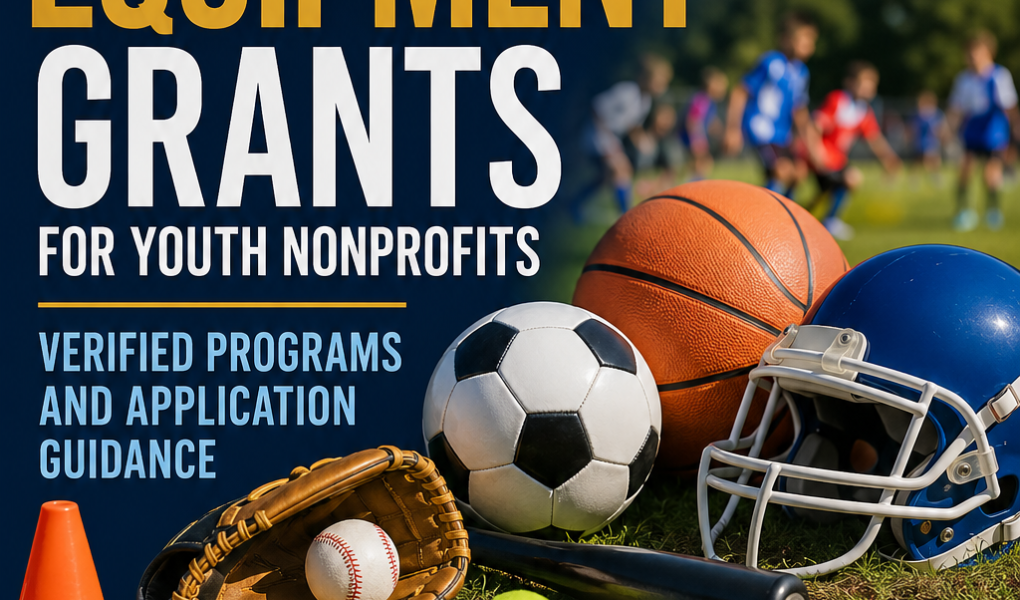
A youth nonprofit may own enough footballs, basketballs, baseball gloves, helmets, uniforms, and training gear to launch a program but not enough to serve the number of young people already waiting to participate. The organization may then make a costly mistake: searching only for cash grants while overlooking equipment-donation programs, sport-specific grant cycles, corporate partnerships, warehouse programs, and product sponsorships.
The search for sports equipment grants for youth nonprofits requires more precision than typing “youth sports grants” into a search engine. Some programs provide money. Others provide new or gently used equipment. Some require the recipient to pay shipping, collect supplies from a regional warehouse, enroll with a national sports body, or operate a particular sport. A funder may support youth development through sports without accepting public equipment requests.
This guide is for nonprofit leaders, grant writers, community organizations, schools, faith-based organizations, and program managers seeking verified funding or donated gear for structured youth sports programs. It explains what equipment funders support, identifies current application routes, and shows how to assess fit before investing time in an application.
Last verified: July 25, 2026
Editorial note: Funding cycles, deadlines, product availability, and eligibility rules may change. Confirm all requirements through the official source before applying. Grant Writing Academy is not affiliated with the organizations listed unless expressly stated. Inclusion in this directory does not mean that every reader or organization will qualify.
What Sports Equipment Funders Actually Support
Sports equipment funding is usually narrower than general youth sports funding. A broad sports grant may support coaching salaries, transportation, facility rentals, league fees, tournaments, capital improvements, or program evaluation. An equipment-focused opportunity may instead provide specific products, a purchasing credit, approved vendor access, or an in-kind package selected by the funder.
Commonly supported items include:
- Balls, bats, gloves, sticks, racquets, goals, nets, cones, and training aids
- Helmets, shoulder pads, protective guards, mouthguards, and safety equipment
- Uniforms, jerseys, footwear, and practice apparel
- Adaptive sports equipment for participants with disabilities
- Physical education equipment for schools and community programs
- Storage, maintenance, or replacement equipment when explicitly permitted
- Sport-specific starter packages for newly established programs
Several verified programs in this article provide equipment rather than unrestricted cash.
Good Sports distributes new sports equipment, apparel, and footwear.
Pitch In For Baseball & Softball focuses on baseball and softball gear.
Leveling the Playing Field redistributes new and gently used equipment through regional warehouses. USA Lacrosse and USA Football operate sport-specific grant cycles.
Equipment programs commonly exclude individual athletes, adult recreational teams, elite travel teams, programs charging high participation fees, prior purchases, organizational debt, unrelated operating costs, and construction. Some programs also expect recipients to pay a percentage of the equipment’s value for shipping or handling.
Geography matters. A national opportunity may still require U.S. operations, while a warehouse-based program may technically serve organizations nationwide but require in-person pickup. Sport-specific programs may require affiliation, an employer identification number, nonprofit status, or evidence that the program operates for a minimum number of weeks.
This makes equipment funding different from the broader opportunities discussed in verified sports grants for nonprofits. Before applying, determine whether the organization needs cash, donated products, uniforms, safety equipment, facility improvements, or a complete program package. The correct funding route depends on the exact need.
Organizations planning related projects may also benefit from these supporting resources:
- Youth sports facility grants for nonprofit organizations
- Sports grants for girls and underserved youth
Verified Sports Equipment Grants and Donation Programs
1. Good Sports Equipment Donation Program
What it supports: Good Sports provides brand-new sports equipment, footwear, and apparel for structured youth sports and physical-activity programs.
Who may qualify: U.S.-based schools and youth-serving organizations that directly serve children ages 3–18 may apply. Programs must serve young people in high-poverty communities, provide regular physical activity, and generally charge participation fees of no more than $299. Schools must meet additional economic-need requirements.
Geographic eligibility: United States.
Funding amount: This is an equipment-donation program rather than a cash grant. Approved organizations may receive access to as many as eight donations over a two-year period, depending on the partnership pathway and available inventory.
Current status: Rolling application.
Application route: Organizations submit the public online application. Good Sports states that applicants generally receive an email response within two to three weeks.
Important restrictions: Individual athletes and families cannot apply. Approved recipients may be responsible for shipping and handling equal to 5% of the donated equipment’s value, although exceptions may apply. Recipients must complete an evaluation after each donation.
What applicants should prepare: Participant ages, program fees, poverty indicators, expected number of young people served, program schedule, requested equipment categories, and evidence that equipment will support consistent physical activity.
Official source: Good Sports equipment donation application and eligibility page.
2. Pitch In For Baseball & Softball Equipment Grant
What it supports: Pitch In For Baseball & Softball provides new and gently used baseball and softball equipment to programs serving children facing economic barriers.
Who may qualify: Leagues, schools, and community-based organizations serving economically disadvantaged children age 18 and younger may apply. The organization considers registration fees, parent costs, school meal eligibility, community need, and the contents of the request.
Geographic eligibility: U.S. and international programs, with different application cycles.
Funding amount: Equipment is awarded in kind. The organization does not publish one standard cash value for every award.
Current status: Open application for the U.S. Fall Cycle from July 1 through September 30, 2026. International applications are accepted on a rolling basis.
Application route: Submit the official online equipment-grant application. Applicants are encouraged to apply at least eight weeks before their season because the full process may take several months.
Important restrictions: Competitive travel teams, individuals, families, most adult programs, and organizations that discriminate are generally ineligible. Recipients may receive one equipment grant per calendar year and are responsible for shipping and handling.
What applicants should prepare: Team numbers, participant ages, season dates, program budget, registration fees, demographic information, school meal data where relevant, other funding sources, an explanation of need, and an equipment list.
Official source: Pitch In For Baseball & Softball application guidelines and process.
For federal, foundation, corporate, public, facility, and broader program opportunities, read the complete pillar guide: Sports Grants for Nonprofits: Verified Funding for Youth Programs, Teams, Facilities, and Equipment.
3. Leveling the Playing Field
What it supports: Leveling the Playing Field supplies free new and gently used sports and recreation equipment to schools, community organizations, after-school programs, recreation centers, and other eligible programs.
Who may qualify: Programs must serve economically disadvantaged young people or children and adults with disabilities. Applicants should operate, or be preparing to operate, a structured sports, recreation, or fitness program for groups rather than individual athletes.
Geographic eligibility: Organizations may receive equipment nationally, but an approved representative must collect it in person from an LPF warehouse.
Funding amount: Equipment donation only. The program does not provide financial assistance.
Current status: Rolling equipment or product donation.
Application route: Submit the application, participate in a site visit or call if requested, and schedule an equipment pickup after approval.
Important restrictions: LPF does not ship equipment directly to beneficiary organizations. Warehouses are currently listed in Baltimore, Silver Spring, Philadelphia, Buffalo, Columbus, Detroit, and Atlanta. Equipment availability varies.
What applicants should prepare: Program information, youth-development goals, number of participants, economic-need evidence, sports offered, equipment needs, program fees, and a realistic pickup plan.
Official source: Leveling the Playing Field application and frequently asked questions pages.
4. USA Lacrosse National Grant Program
What it supports: USA Lacrosse offers equipment grants for youth and high-school boys’, girls’, and co-gender lacrosse organizations. Equipment options may include sticks and helmets. Physical education grants may include equipment bundles and instructional curriculum.
Who may qualify: U.S. programs directly serving young people ages 6–19 may apply, with priority given to programs serving participants age 14 and younger. Applicants need experienced leadership, a structured program lasting at least six weeks, demonstrated financial need, and an employer identification number.
Geographic eligibility: United States.
Funding amount: Equipment is provided in kind. A standard equipment-award dollar amount is not published.
Current status: Open application through July 31, 2026.
Application route: Submit the formal USA Lacrosse grant application during the published cycle.
Important restrictions: USA Lacrosse gives preference to programs serving girls, both versions of the game, diverse communities, and eligible 501(c)(3) organizations. Grant recipients must complete post-award reflection or reporting requirements.
What applicants should prepare: EIN, leadership information, program calendar, participant ages, financial-need evidence, community demographics, requested equipment, program objectives, and a plan for using and maintaining the equipment.
Official source: USA Lacrosse National Grant Program announcement, offerings, and eligibility guidelines.
5. USA Football Fall Grants
What it supports: USA Football’s grant program supports equipment and resources such as uniforms, flag belts, footballs, padded-flag equipment, helmets, shoulder pads, and selected safety gear.
Who may qualify: Eligible applicants include nonprofit youth football organizations, municipal youth programs, middle schools, and high-school girls’ flag football programs. Applicants must enroll with USA Football and be in good organizational standing.
Geographic eligibility: United States.
Funding amount: USA Football does not publish one guaranteed award amount. Successful applicants receive an award notice explaining the approved amount, equipment, and redemption process.
Current status: Open application from July 22 through September 2, 2026.
Application route: Enroll with USA Football and complete the grant application during the current cycle.
Important restrictions: High-school tackle programs, adult programs, for-profit organizations, applicants with outstanding invoices, and prior equipment purchases are not eligible. The Fall Grant is intended for future program needs rather than reimbursement or urgent current-season purchases.
What applicants should prepare: Legal-status information, participant ages, game types, prior grant history, equipment selection, intended use, and a concise explanation of how the award will improve participation or safety.
Official source: USA Football Fall Grant eligibility and application guidance.
6. The Skatepark Project — Supply the Ride
What it supports: Supply the Ride distributes action-sports equipment such as skateboards, helmets, protective pads, and BMX bicycles through product giveaways, community events, clinics, and local partnerships.
Who may qualify: The program works with local organizations, municipalities, and social-skate groups serving underserved communities. The official page invites communities interested in hosting a Supply the Ride event to apply.
Geographic eligibility: Primarily communities in the United States, subject to partnership selection and program capacity.
Funding amount: Product donation and event partnership. No fixed cash amount or standard equipment value is published.
Current status: Partnership-based equipment or product donation.
Application route: Submit the official interest application for a potential Supply the Ride community event.
Important restrictions: This is not presented as an unrestricted public cash grant. An application does not guarantee that an event or equipment distribution will be approved.
What applicants should prepare: Community-need evidence, local partners, expected participant numbers, event capacity, action-sports programming information, safety plans, and a clear explanation of how the equipment will remain accessible after the event.
Official source: The Skatepark Project Supply the Ride program page.
GET VERIFIED FUNDING UPDATES AND PRACTICAL GRANT GUIDANCE
Grant opportunities, deadlines, eligibility rules, and application routes can change. Join the Grant Writing Academy newsletter for verified funding directories, grant research guidance, application strategies, templates, and new resources.
JOIN THE FREE GRANT WRITING ACADEMY NEWSLETTER
How to Determine Whether Your Organization Is a Strong Fit
A sports program can have a powerful mission and still be unsuitable for a particular equipment funder. Alignment depends on the organization’s legal structure, location, participants, program design, fees, sport, timeline, and ability to meet operational requirements.
Start with legal and geographic eligibility. Confirm whether the applicant must be a 501(c)(3), school, municipal department, fiscally sponsored project, league, or community organization. An organization should not assume that operating in the United States is enough when a grant is limited to specific warehouse locations, sports, age groups, or affiliated programs.
Next, compare the funder’s priorities with the actual program. A grant intended to remove financial barriers may not fit an elite travel team charging substantial fees. An equipment donor may prioritize programs serving young people from low-income communities, but the applicant may need credible evidence such as school meal eligibility, census data, household-income indicators, scholarship rates, or a clear fee structure.
Organizational readiness also matters. Equipment must be stored, maintained, distributed, monitored, and replaced responsibly. Applicants should demonstrate safeguarding procedures, qualified coaches, background-check practices, financial controls, participant registration systems, injury protocols, and the capacity to complete required reports.
Use the grant readiness checklist for nonprofits before applying, and record each prospect in a grant research tracker for nonprofit organizations.
Funding Fit Checklist
Ask these questions before moving an opportunity into the active application pipeline:
- Does the program fund our exact sport or equipment category?
- Is our organization an eligible legal entity?
- Does the funder support organizations in our location?
- Are our participants within the required age range?
- Can we document the economic or community need?
- Are our participation fees within the funder’s limits?
- Is the equipment request proportional to the number of participants?
- Can we pay required shipping, handling, or pickup costs?
- Do we have safe storage and an equipment-management plan?
- Can we meet safeguarding and background-check expectations?
- Does the funder accept public applications?
- Can we complete the application without rushing or inventing information?
- Are we prepared to collect participation and outcome data?
- Can we satisfy post-award reporting requirements?
- Have we confirmed that the equipment will arrive before the relevant season?
A “no” answer does not always mean the organization must abandon the opportunity. It may indicate that the team should resolve a readiness gap, clarify a rule with the funder, build a local partnership, or place the prospect in a future-cycle pipeline rather than applying immediately.
How to Prepare a Competitive Sports Equipment Grant Application
A strong equipment request explains more than what the organization wants to purchase. It shows who will use the equipment, what barrier currently prevents participation, why the requested quantity is reasonable, how the equipment will improve the program, and how the organization will protect the investment.
Begin with a specific problem statement. Explain whether children are sharing unsafe equipment, families cannot afford required gear, outdated helmets no longer meet safety expectations, participant enrollment has outgrown current inventory, or the organization cannot launch a girls’ or adaptive division without specialized equipment.
Use recent local evidence. This may include the number of children on a waiting list, school meal eligibility, neighborhood-income data, registration scholarship requests, parent surveys, equipment inspection records, participant retention, or the number of young people turned away during the previous season.
Connect each item to program delivery. Instead of submitting a broad wish list, create a quantity-based request tied to enrollment:
- Number of participants expected
- Number of teams or program sites
- Equipment already available
- Items that can still be used safely
- Items requiring replacement
- New items needed to expand participation
- Cost or value per unit
- Shipping, storage, and maintenance arrangements
Define outputs and outcomes separately. Outputs may include 120 young people receiving equipment, 24 weekly sessions delivered, or four new teams established. Outcomes may include increased participation, improved attendance, reduced family costs, stronger retention, increased physical activity, or fewer equipment-related safety incidents.
Weak:
“Our organization needs new football equipment so more children can play.”
Stronger:
“During the 2026–2027 program year, our nonprofit will provide a 20-week flag football program for 120 young people ages 8–14. Sixty-four percent of participants attend schools where most students qualify for free or reduced-price meals.
The requested 80 flag belts, 24 footballs, 120 mouthguards, and 40 replacement helmets will allow us to increase enrollment by 30 participants, retire damaged equipment, and reduce the family participation fee from $175 to $75. We will track enrollment, attendance, retention, fee scholarships, equipment distribution, and reported injuries.”
The stronger version presents a defined population, program period, equipment list, financial barrier, expected change, and evaluation plan.
Tailor every application. A baseball-equipment donor will not need the same narrative as a football-governing body or an action-sports partnership. Use a grant proposal template for nonprofit organizations to organize the narrative, but revise the language around the funder’s exact criteria.
Build a complete request budget with the grant budget template for nonprofit programs, including shipping, handling, maintenance, storage, installation, and any costs the grant will not cover.
STOP MANAGING YOUR FUNDER RESEARCH IN RANDOM DOCUMENTS
Finding a promising funder is only the beginning. You still need to record eligibility, deadlines, award ranges, relationship activity, application status, reporting dates, and renewal opportunities.
The Grant Pipeline Command Center helps nonprofits and grant professionals organize funder research and manage the full funding pipeline in one practical system.
JOIN THE NEWSLETTER FOR THE PRODUCT RELEASE
How to Build a Strategic Funding Pipeline for Sports Equipment
A strategic pipeline separates opportunities that deserve immediate attention from those requiring relationship development or future monitoring. Record the official program name, equipment category, geographic rules, participant requirements, deadline, application route, shipping obligations, reporting expectations, last verification date, and next action.
1. Priority A: Apply or Prepare Now
Place a funder in Priority A when eligibility is confirmed, the equipment matches the program, the award size or product package is realistic, and an active or upcoming deadline exists.
USA Lacrosse, USA Football, and the current PIFBS Fall Cycle may belong here for organizations that meet their sport-specific requirements and can prepare a complete application before the published deadlines.
2. Priority B: Build the Relationship
Use Priority B for partnership-based programs, local corporate sponsors, invitation-only foundations, community foundations requiring introductions, and programs that may need preliminary communication.
Record a specific relationship action, such as requesting an eligibility clarification, attending an information session, identifying a board introduction, proposing an equipment drive, or approaching a local business about sponsorship.
3. Priority C: Monitor
Place closed cycles, uncertain prospects, and future expansion opportunities in Priority C. Record the expected opening month and schedule a review several weeks before the anticipated cycle. Do not rely on last year’s deadline without checking the official page.
Maintain reusable documents, including the determination letter, board list, current budget, safeguarding policy, coach qualifications, equipment inventory, participant demographics, program calendar, outcome data, financial statements, and standard organizational description. Review the pipeline monthly, record rejection feedback, plan renewals, and remove prospects that are outdated or repeatedly misaligned.
Equipment grants should form one part of the funding strategy. Organizations may also combine grants with local sponsors, individual donors, equipment drives, league revenue, municipal partnerships, school agreements, and reasonable earned income. The goal is not to submit the largest number of applications. It is to develop a balanced pipeline containing opportunities the organization can realistically win, manage, and report on.
Organizations needing proposal or research assistance can review grant writing services for nonprofit organizations.
NEED FUNDERS MATCHED TO YOUR ORGANIZATION?
A public article cannot account for every detail of your organization, including your legal structure, location, population, program design, budget, funding history, and current readiness.
Grant Writing Academy provides customized funder research to help organizations identify and prioritize potential opportunities that may align with their work. Research may include eligibility notes, official links, deadlines, restrictions, application routes, and recommended next steps.
REQUEST CUSTOMIZED FUNDER RESEARCH, email: grantwritingacademyconsult@gmail.com
Customized funder research identifies potential matches but does not guarantee eligibility, invitations, or grant awards.
Frequently Asked Questions
1. Can a new nonprofit apply for sports equipment grants?
A new nonprofit may qualify when the opportunity does not require a lengthy operating history. However, the organization still needs to demonstrate legal eligibility, responsible leadership, a defined program, realistic participant numbers, safe equipment management, and the ability to complete reporting. A new organization without 501(c)(3) recognition should check whether a school, municipality, eligible community organization, or fiscal sponsor can serve as the applicant. Do not use another organization solely to access funding; the partnership must reflect genuine responsibility for the program and award.
2. Can faith-based organizations receive youth sports equipment grants?
Faith-based organizations may qualify when they meet the same nonprofit, geographic, participant, program, and financial-need requirements as other applicants. The listed programs do not provide automatic eligibility based on religious identity. Keep grant-funded sports services accessible and nondiscriminatory, and do not assume donated equipment may be restricted to religious instruction or participation in worship. Where guidelines are silent, ask the funder whether faith-based applicants are eligible and whether any separation between sports programming and religious activities is required.
3. Can an equipment grant also pay salaries or operating expenses?
Usually not when the award is an in-kind equipment donation. Product-donation programs generally provide approved equipment rather than money that the recipient can redirect to salaries, rent, or general operations. A separate cash grant may permit coaching, transportation, insurance, staffing, or administration, but only when the official guidelines identify those expenses as eligible. Build a full program budget so the organization knows how it will cover costs that remain after the equipment award.
4. What documents should applicants prepare?
Common documents include the IRS determination letter, EIN, current organizational budget, program budget, board list, safeguarding policy, coach or staff qualifications, participant demographics, equipment inventory, program calendar, proof of insurance, financial statements, vendor quotes, school meal data, registration-fee schedule, and partnership letters. Not every funder requests every attachment, but preparing a centralized grant-readiness file prevents rushed applications and inconsistent information.
5. How should a nonprofit approach a partnership-based equipment program?
Begin by understanding the partner’s goals rather than sending a generic request. Present the community need, number and ages of participants, sport, event or program structure, local partners, equipment distribution plan, safety procedures, media capacity where appropriate, and how the equipment will remain accessible after the partnership. Ask about the correct application route and decision timeline. A partnership-based opportunity should be tracked as a relationship prospect until the organization receives clear instructions or an invitation to submit additional information.
Conclusion
A verified sports equipment opportunity is the beginning of the process, not proof that an organization should apply. The nonprofit must still confirm its legal status, geography, participant ages, economic-need criteria, program fees, sport, equipment requirements, timeline, and reporting capacity.
A focused pipeline containing six well-matched prospects is more valuable than a spreadsheet containing 100 outdated funder names. Prioritize opportunities that match the actual program, prepare a quantity-based equipment request, explain how the award will remove a documented barrier, and verify every requirement through the official source immediately before submission.
Organizations without the capacity to research cycles, interpret eligibility rules, prepare budgets, or tailor applications may benefit from professional support. Quality, timing, and alignment should guide the funding strategy—not application volume.
BUILD A STRONGER FUNDING PIPELINE WITH ONGOING SUPPORT
The Grant Writing Academy Founding Membership is designed for nonprofit leaders, grant writers, consultants, faith-based organizations, and mission-driven teams that need ongoing help with funder research, grant readiness, opportunity evaluation, proposal development, grant budgets, application review, and funding systems.
Founding Members receive monthly coaching, practical tools, strategic guidance, and continuing accountability throughout the year.
EXPLORE THE GRANT WRITING ACADEMY FOUNDING MEMBERSHIP
Similar Recommended Articles
- Football Equipment Grants for Youth Nonprofits and Community Teams.
- Baseball and Softball Equipment Donation Programs for Nonprofits.
- Sports Grants for Girls and Underserved Youth Programs.
- Youth Sports Facility and Field Improvement Grants.
- Grants for Adaptive Sports Equipment and Inclusive Recreation.