A youth sports nonprofit may describe its problem as “not having enough equipment,” but that sentence can hide several very different needs. One league may need twenty age-appropriate gloves that remain the property of the program. Another may need catcher’s equipment, batting helmets, bases, softballs, and team bags. A third may already own equipment, but much of it is damaged, incorrectly sized, unsafe, or unsuitable for the age group being served.
This distinction matters when researching baseball and softball equipment donation programs for nonprofits. Some programs provide physical equipment rather than cash. Some require recipients to pay shipping or collect the equipment from a regional warehouse.
Others only support organizations already affiliated with a national baseball program. Regional foundations may offer cash that can be used for equipment, uniforms, field improvements, or league development, but only within a defined geographic territory.
A generic list of sports grants will not tell you whether a funder supports individual athletes, competitive travel teams, school programs, recreational leagues, international organizations, or faith-based community programs. This guide explains what baseball and softball equipment funders commonly support, which verified programs organizations can investigate, how to determine fit, and how to prepare a stronger request.
What Baseball and Softball Equipment Donation Programs Support
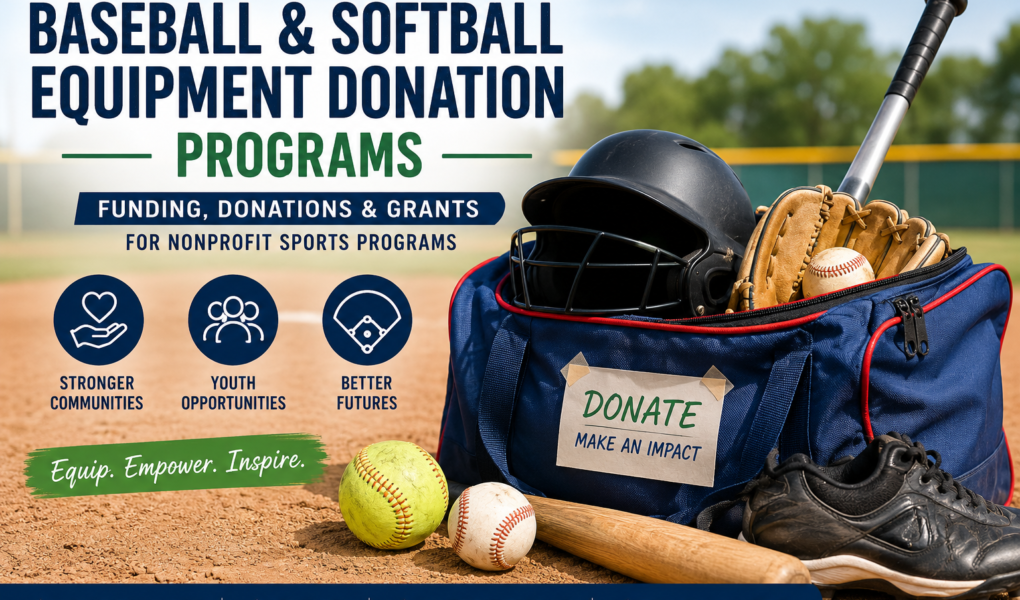
Baseball equipment grants for youth nonprofits are often provided as in-kind donations rather than unrestricted money. An approved organization may receive bats, gloves, batting helmets, baseballs, softballs, catcher’s equipment, equipment bags, tees, throw-down bases, uniforms, footwear, or apparel. The exact items may depend on available inventory, participant ages, program format, number of players, existing equipment, and documented financial need.
Equipment funders commonly prioritize organizations that serve children from low-income communities, reduce or eliminate participation fees, lend equipment to players, provide structured programming throughout a season, and combine sports with youth development. Some funders also prioritize girls, rural communities, children with disabilities, historically underserved populations, or programs recovering from disasters.
The most important distinction is that an equipment donation is not automatically a cash grant. Organizations may still be responsible for shipping, handling, customs charges, warehouse collection, storage, distribution, maintenance, or post-donation reporting.
Good Sports, for example, requires approved organizations to pay a fee equal to 5% of the donated equipment’s value, while Pitch In For Baseball & Softball requires recipients to cover shipping and handling. Leveling the Playing Field provides equipment without cash assistance but requires approved recipients to collect items from a warehouse.
Common exclusions include:
- Donations to individual children or families
- Equipment for adult recreational teams
- Competitive travel or showcase teams
- Tournament-only or short-term events
- Programs charging high participation fees
- Requests unrelated to baseball, softball, or structured physical activity
- Reimbursement for equipment already purchased
- General organizational debt
- Requests that cannot demonstrate financial need
- Programs without adequate safeguarding or equipment-management procedures
This narrow funding area differs from the broader field of verified sports grants for nonprofits because the central question is not simply who funds youth sports. It is whether an organization can receive usable baseball or softball gear, where that gear must be collected, what costs remain the organization’s responsibility, and whether the opportunity is open to the public or limited to an existing partner network.
Organizations comparing other equipment categories may also review sports equipment grants for youth nonprofits and football equipment grants for youth nonprofits and community teams.
Verified Baseball and Softball Equipment Donation Programs
The following programs were selected because their official websites identify a current equipment-donation route, an active affiliation process, or a recent grant cycle that specifically supports baseball and softball equipment.
1. Pitch In For Baseball & Softball Equipment Grants
Opportunity type: Equipment or product donation; periodic U.S. application and rolling international application.
What it supports: Pitch In For Baseball & Softball, commonly called PIFBS, provides baseball and softball equipment to leagues, schools, and community-based organizations serving economically disadvantaged children age 18 and younger.
Who may qualify: Eligible applicants include leagues, schools, and community organizations. Competitive travel teams, individual families, adult programs, and discriminatory programs are excluded. Military, veterans, and disability-serving programs may receive limited exceptions to the age or financial-need requirements.
Geographic eligibility: U.S. organizations use the domestic application. Organizations outside the United States use the international application.
Funding amount: No cash award range is published. Assistance is provided as equipment based on the approved request and available resources.
Current status: The U.S. fall application period runs from July 1 through September 30, 2026. International applications are accepted on a rolling basis.
Application route: Submit the appropriate online equipment application. U.S. applicants should generally apply at least eight weeks before their season. International processing may take more than six months.
Important restrictions: Recipients may receive one PIFBS equipment grant per calendar year and must pay shipping and handling. International recipients may also be responsible for customs-related expenses. Post-season impact reporting is required.
What applicants should prepare: Participant numbers and ages, registration fees, evidence of financial need, current equipment inventory, exact quantities requested, season dates, delivery information, and previous PIFBS reporting records.
Official sources: U.S. equipment application and international equipment application.
2. Good Sports Equipment Donation Opportunity
Opportunity type: Equipment or product donation; open application.
What it supports: Good Sports provides brand-new sports equipment, apparel, and footwear to approved schools and youth-serving organizations. Baseball and softball programs can request gear through the general equipment-donation application.
Who may qualify: Organizations must directly serve young people ages 3–18, operate in high-poverty communities, charge participation fees of $299 or less, and provide consistent access to physical activity. Schools must be tuition-free, and more than half of students must qualify for free or reduced-price lunch.
Geographic eligibility: United States.
Funding amount: No cash range is published. Approved organizations may access up to eight equipment donations over two years, subject to inventory and approval.
Current status: Open application. The official page does not publish a fixed closing date.
Application route: Community organizations and schools use separate online applications.
Important restrictions: Individual children and families cannot apply. Approved organizations generally pay shipping and handling equal to 5% of the donated equipment’s value, sign a release, and submit an evaluation after each donation. Meeting minimum requirements does not guarantee approval.
What applicants should prepare: Youth demographics, participation costs, program schedule, poverty indicators, equipment needs, delivery address, organizational information, and a plan for retaining and using donated gear.
Official source: Good Sports program application.
3. Leveling the Playing Field Equipment Grant
Opportunity type: Equipment or product donation; regional warehouse opportunity.
What it supports: Leveling the Playing Field distributes new and gently used sports equipment, including baseball and softball gear, to schools and community organizations that provide affordable, structured youth sports and recreation.
Who may qualify: Programs must serve economically disadvantaged children or people with disabilities, offer free or low-cost activities, serve groups rather than individuals, and include a youth-development component beyond athletic performance.
Geographic eligibility: The organization operates warehouses serving Greater Washington, Baltimore, Philadelphia, Western New York, Central Ohio, Southeast Michigan, and Atlanta. Applicants must be able to collect equipment in person, and some newer locations may not yet offer recipient pickup.
Funding amount: No cash is awarded. Assistance consists of available equipment.
Current status: The online equipment application is active, with no fixed public deadline stated.
Application route: Submit the equipment-grant form, complete a site visit or call, and schedule a warehouse appointment after approval.
Important restrictions: Equipment is not shipped to recipient programs. Applicants should not apply unless an authorized representative can travel to an operating warehouse.
What applicants should prepare: Program schedule, participant numbers, financial-need information, existing inventory, requested gear, transportation arrangements, and evidence that the program offers consistent youth development.
Official source: Leveling the Playing Field equipment application.
4. MLB Nike RBI Affiliation and Equipment Support
Opportunity type: Local affiliate opportunity and existing-partner support.
What it supports: Newly affiliated Nike Reviving Baseball in Inner Cities programs receive equipment based on their programming. Structured leagues may receive team kits containing bats, gloves, helmets, balls, catcher’s equipment, and a team bag. Recreational programs may receive plastic or foam bats and balls and throw-down bases.
Who may qualify: Organizations must complete the Nike RBI affiliation process and operate baseball or softball programming focused on young people in underserved communities.
Geographic eligibility: Nike RBI includes programs in the United States and internationally.
Funding amount: No standard cash value is published. Equipment quantities are based on participant numbers and program format. Affiliated leagues may also request cash support for equipment, capital improvements, or capacity building by submitting a formal request letter and project budget to the RBI National Office.
Current status: The affiliation inquiry form is active. This is not an unrestricted public equipment grant; support depends on becoming and remaining an RBI affiliate.
Application route: Initiate affiliation through MLB’s official form. Good Sports also offered a separate 2026 equipment round for existing Nike RBI programs, but that application closed on February 20, 2026.
Important restrictions: Organizations should not describe themselves as RBI affiliates until approved.
Official sources: Affiliate with Nike RBI and Nike RBI affiliation benefits.
5. Globe Life Texas Rangers Baseball and Softball Grant Program
Opportunity type: Periodic regional cash grant; closed for the current cycle.
What it supports: The program supports field renovations, equipment needs, uniforms, and league development for youth baseball and softball organizations in the Texas Rangers’ five-state territory.
Who may qualify: The 2026 opportunity targeted eligible nonprofit youth baseball and softball organizations serving participants age 18 or younger.
Geographic eligibility: Arkansas, Louisiana, New Mexico, Oklahoma, and Texas.
Funding amount: A standard per-award range was not published on the accessible 2026 official program page. Applicants should never estimate an award amount based only on previous recipients.
Current status: Closed as of June 30, 2026. Monitor the official page for the next announced cycle. Grant recipients were scheduled to be announced in August 2026.
Application route: Organizations applied through the Rangers Foundation’s official program page and application portal.
Important restrictions: Organizations were limited to one application per calendar year, and proposed work had to directly support youth baseball or softball.
What applicants should prepare: Proof of nonprofit status, program location, youth participation data, an itemized equipment or project budget, vendor estimates, project timeline, and explanation of how the request will increase participation.
Official source: Globe Life Texas Rangers grant program.
For a broader list of federal, foundation, corporate, and public sports-funding sources, read our complete guide: Sports Grants for Nonprofits: Verified Funding for Youth Programs, Teams, Facilities, and Equipment.
GET VERIFIED FUNDING UPDATES AND PRACTICAL GRANT GUIDANCE
Grant opportunities, deadlines, eligibility rules, and application routes can change.
Join the Grant Writing Academy newsletter for verified funding directories, grant research guidance, application strategies, templates, and new resources.
JOIN GRANT WRITING ACADEMY NEWSLETTER
How to Determine Whether Your Organization Is a Strong Fit
A strong mission does not automatically create funder alignment. A nonprofit may serve low-income children and still be unsuitable because it operates a competitive travel team, charges fees above the limit, cannot collect equipment, needs cash rather than products, or wants items that the program does not distribute.
Before applying, use this Funding Fit Checklist:
- Does the program support baseball, softball, or multi-sport equipment that includes our requested items?
- Is our legal entity type eligible?
- Does the program serve our city, state, region, or country?
- Are our participants within the required age range?
- Can we demonstrate economic need using fees, school-lunch data, neighborhood data, or scholarship rates?
- Is our program recreational, developmental, school-based, or community-based rather than a pay-to-play showcase team?
- Does the funder accept direct applications, or must we become an affiliate?
- Can we pay shipping, handling, customs, or administration costs?
- Can someone collect the equipment if shipping is unavailable?
- Do we have secure storage and a system for distributing, inspecting, and recovering gear?
- Can we submit required photographs, evaluations, participant data, and impact reports?
- Is the equipment likely to arrive before the season starts?
- Can we provide safeguarding policies, insurance, coach-screening procedures, and emergency plans?
- Is our request based on documented inventory rather than a rough estimate?
- Are we prepared to remove the opportunity if it is closed or no longer aligned?
Record every answer in a grant research tracker for nonprofits. Before pursuing larger cash requests, complete a nonprofit grant-readiness assessment so missing governance, financial, program, or safeguarding documents do not delay the application.
Faith-based organizations may be eligible where the funder accepts community-based youth organizations and does not expressly exclude religious entities. However, the sports program should satisfy all public-benefit, nondiscrimination, age, geographic, and financial-need requirements. This is a practical eligibility inference, not confirmation that every faith-based applicant will qualify.
How to Prepare a Competitive Equipment Request
Begin with an equipment audit. Count usable items by type, size, age group, condition, and ownership. Do not report forty gloves if only twelve are safe and correctly sized. Explain how many teams, players, practices, and games the requested equipment will support.
Describe the financial barrier with evidence. Useful information may include registration fees, the percentage of participants receiving scholarships, school-lunch eligibility, neighborhood poverty data, family surveys, waiting lists, and the number of children currently sharing equipment.
Connect the need to participation: explain whether children are being turned away, borrowing unsafe gear, rotating through limited equipment, or paying costs that prevent enrollment.
Provide an itemized request such as:
- 24 youth gloves in specified size ranges
- 6 approved batting helmets
- 2 complete catcher’s sets
- 8 bats matched to participant ages
- 12 dozen practice baseballs or softballs
- 4 equipment bags
- 3 batting tees
- 2 sets of throw-down bases
Avoid mixing essential equipment with unrelated requests. Show how the organization will label, store, inspect, sanitize, lend, recover, and eventually replace the gear.
Weak:
“Our nonprofit needs baseball equipment so more children can play.”
Stronger:
“During the 2027 spring season, our eight-week community baseball program will serve 96 children ages 7–13 from four low-income neighborhoods. Our inventory audit found that only 18 of 47 donated gloves are safe and appropriately sized. We are requesting 30 youth gloves, eight batting helmets, two catcher’s sets, six bats, and practice balls. The equipment will remain program property, be issued through a signed lending system, inspected before each session, and in our secured recreation facility.”
Tailor the final request using a grant proposal template for nonprofits and an itemized grant budget template. Organizations that need proposal development or application review can also explore Grant Writing Academy services.

STOP MANAGING YOUR FUNDER RESEARCH IN RANDOM DOCUMENTS
Finding a promising funder is only the beginning. You still need to record eligibility, deadlines, award ranges, relationship activity, application status, reporting dates, and renewal opportunities.
The Grant Pipeline Command Center helps nonprofits and grant professionals organize funder research and manage the full funding pipeline in one practical system.
GET THE GRANT PIPELINE COMMAND CENTER
How to Build a Strategic Funding Pipeline for Equipment Needs
Do not place every sports funder on one undifferentiated list. Separate equipment-in-kind programs from cash grants, sponsorships, local team foundations, affiliation benefits, field-improvement funding, and emergency-replacement opportunities.
Priority A: Apply or prepare now
Include opportunities with confirmed eligibility, an active or upcoming application period, realistic delivery arrangements, and direct support for the exact equipment needed. As of July 27, 2026, this could include the PIFBS fall cycle, PIFBS international applications, Good Sports, Leveling the Playing Field where warehouse collection is practical, or the Nike RBI affiliation process.
Priority B: Build the relationship
Include local professional teams, corporate sponsors, recreation departments, sporting-goods retailers, community foundations, and affiliate-based programs. Record the person to contact, the relationship action, the next follow-up date, and whether a referral or introduction may be required.
Priority C: Monitor
Include closed programs such as the 2026 Globe Life Texas Rangers cycle and the 2026 Good Sports–Nike RBI round. Record the previous opening date, closing date, geographic rules, official page, and a reminder to check for the next cycle. Do not copy an old deadline forward as though it were confirmed.
Review the pipeline monthly. Remove programs that no longer fit, record rejection feedback, prepare reusable documents, and schedule applications around the sports calendar. Diversify the pipeline by combining product donations with local sponsorships, individual donors, fundraising events, registration revenue, municipal partnerships, and appropriate cash grants.
NEED FUNDERS MATCHED TO YOUR ORGANIZATION?
A public article cannot account for every detail of your organization, including your legal structure, location, population, program design, budget, funding history, and current readiness.
Grant Writing Academy provides customized funder research to help organizations identify and prioritize potential opportunities that may align with their work. Research may include eligibility notes, official links, deadlines, restrictions, application routes, and recommended next steps.
REQUEST CUSTOMIZED FUNDER RESEARCH
Customized funder research identifies potential matches but does not guarantee eligibility, invitations, or grant awards.
Frequently Asked Questions
1. Can a new nonprofit receive donated baseball or softball equipment?
A new nonprofit may qualify when the program does not impose a minimum operating-history requirement. However, it must still demonstrate legal standing, a real participant base, an organized season, financial need, responsible adult leadership, equipment storage, safeguarding procedures, and the capacity to complete reporting. A newly incorporated organization with no scheduled activities, participant records, coaches, facility access, or equipment-management plan may struggle to demonstrate readiness.
2. Can faith-based organizations apply for baseball equipment donations?
Potentially. Several verified programs describe eligible applicants broadly as leagues, schools, nonprofits, or community-based youth organizations. Faith-based organizations should confirm that the sports program is open to eligible participants without prohibited discrimination and that donated equipment will support the approved community activity rather than worship, religious instruction, or an unrelated organizational purpose. Contact the funder when the guidelines do not address religious organizations directly.
3. Can equipment programs provide uniforms and footwear?
Some can. Good Sports distributes equipment, apparel, and footwear, while regional cash-grant programs may permit uniforms. Other programs concentrate on reusable playing equipment such as gloves, bats, helmets, catcher’s gear, balls, bags, and bases. Never assume that “equipment” includes customized jerseys, personal footwear, transportation, registration fees, facility construction, or items already purchased.
4. What documents should an organization prepare?
Prepare proof of nonprofit or school status where required, board and leadership details, participant demographics, season dates, registration fees, financial statements, an operating budget, an equipment inventory, itemized request, vendor quotations for cash grants, safeguarding policies, insurance information, coach-screening procedures, photographs, facility information, storage plans, and previous impact reports. International applicants may also need customs, freight, receiving, and import information.
5. Should a nonprofit apply to several equipment programs at once?
It may pursue more than one opportunity, but it should disclose confirmed donations when asked and avoid requesting duplicate quantities that it no longer needs. Some funders coordinate with partners or limit recipients to one donation during a calendar year. Maintain a live inventory and update pending requests whenever another donation changes the remaining gap. Ethical, accurate requests protect the organization’s credibility and help limited equipment reach more children.
Conclusion
A verified equipment program is only the beginning. Your organization must still confirm legal, geographic, financial, age, program, delivery, and reporting eligibility. The strongest request identifies an exact equipment gap, connects that gap to participation barriers, and explains how every donated item will be safely managed.
A focused pipeline of five well-matched opportunities is more useful than a spreadsheet containing fifty outdated sports funders. Prioritize quality, verify every official page before applying, and seek professional research support when your team lacks the time or capacity to evaluate opportunities properly.
BUILD A STRONGER FUNDING PIPELINE WITH ONGOING SUPPORT
The Grant Writing Academy Founding Membership is designed for nonprofit leaders, grant writers, consultants, faith-based organizations, and mission-driven teams that need ongoing help with funder research, grant readiness, opportunity evaluation, proposal development, grant budgets, application review, and funding systems.
Founding Members receive monthly coaching, practical tools, strategic guidance, and continuing accountability throughout the year.
EXPLORE THE GRANT WRITING ACADEMY FOUNDING MEMBERSHIP
Similar Recommended Articles
- Football Equipment Grants for Youth Nonprofits and Community Teams.
- Baseball and Softball Equipment Donation Programs for Nonprofits.
- Sports Grants for Girls and Underserved Youth Programs.
- Youth Sports Facility and Field Improvement Grants.
- Grants for Adaptive Sports Equipment and Inclusive Recreation.